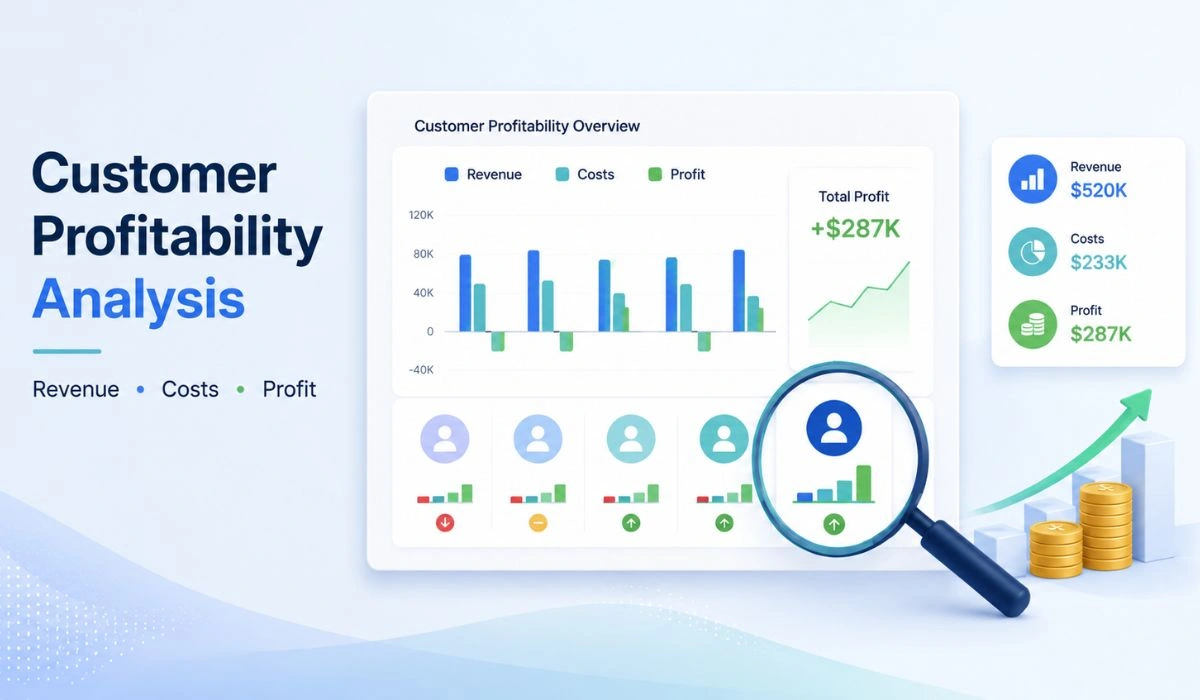


If you are into the SaaS business, then surely you would have heard of the term customer lifetime value. It gives you the overall revenue an average customer generates during their entire relationship with a business. But wouldn’t it be more beneficial to know what profit (rather than revenue) a customer generates? Customer profitability analysis is intended towards that.
The “biggest” customers might not always be the ones that generate the most profit for your organisation. Customer profitability analysis can help you identify the customers who contribute the most long-term value.
This guide will take you through the definition, formula, benefits, examples, and practical Customer Success applications of customer profitability. By the end of this, you will be able to evaluate whether it is beneficial over traditional customer lifetime value analysis.
The concepts discussed in this blog are primarily about SaaS companies and products, but it is more or less applicable to traditional business models as well.
Customer Profitability Analysis Definition
CPA is a managerial accounting method that allows businesses to determine the overall profit a customer generates. A profitable customer is someone who generates a revenue stream greater than the cost of their acquisition, selling, and serving. Companies calculate the CPA on a customer level or for the entire customer group.
When companies are more focused on products, departments, and locations of their offices, they often tend to lose focus on the customers. As a result, the companies have to sometimes bear the cost of maintaining unprofitable customers which is detrimental to their business.
CPA allows companies to evaluate their customers and know how beneficial it is for them to keep the customers. Based on this value they can decide upon the cost of serving them or even to decide whether to continue or let them go. It measures profitability at the individual customer or customer-segment level.
Especially for SaaS companies, the initial acquisition costs can be heavy. This can overtake revenues for the first few months. For instance, ERP (Enterprise Resource Planning) platforms like Netsuite and SAP have high initial costs due to their unique requirements. An effective CPA is required in such instances instead of a broad calculation of revenue generated.
It has been found in a study that the size of the customer is not directly proportional to their profitability. Sometimes even the large-sized customers can turn out to be unprofitable ones for a business.
Customer Profitability Analysis Formula Explained
Not all customers or customer segments generate revenue and incur costs in the same way. That is why Net Profit is not enough to calculate customer profitability. To find the customer profitability, you need to know the true revenue generated and true costs incurred by that customer
The total revenue can be generated from the following sources :
| Revenue Source | Description |
| Recurring revenue | Revenue generated from a customer when they renew their subscription to a SaaS |
| Upgrades to higher plans | Offering better plans with different parameters based on customer value and needs (upselling) |
| Cross-selling relevant products | Encouraging an existing customer to subscribe to other products from your SaaS catalog |
And, expenses can be incurred from the following sources which also you need to consider:
| Cost Source | Description |
| Customer support | One of the major expenses of a SaaS company; products require extensive support |
| Customer success team | Maintained to ensure customer needs don’t get lost between marketing and support teams |
| Direct costs | Expenses related to hosting, delivering, and supporting software for active users |
| Indirect costs | Overhead operational costs (sales, R&D, etc.) |
When you have both the true revenue and true cost for a specific customer or a specific segment of customers, you can calculate Customer Profitability this way:
CPA = Total Revenue from a Customer -Total Cost to Serve that Customer
For instance if the total revenue generated by a customer in a year is $100,000 and total expense incurred to serve that customer in a year is $50,000, then Customer Profitability is:
$100,000 – $50,000 = $50,000
This formula is not universally applicable. The way customer costs are allocated may not be the same for all companies.
Factors That Affect Customer Profitability
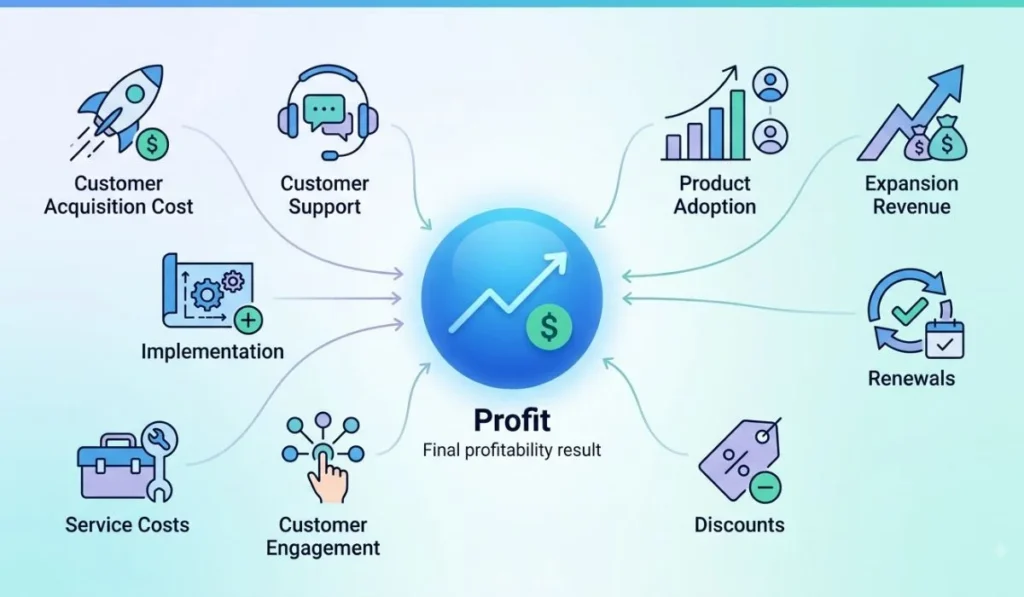
If your expenses are higher than your revenue, you are not profitable. It is a simple enough equation. But oftentimes, businesses misjudge expenses and factors that are at play in this equation. If something affects your revenue or your costs, it will directly affect your profits. The factors that largely influence customer profitability are:
| Factor | Effect on Profitability |
| Customer acquisition cost (CAC) | Sales and marketing expenses incurred before a customer even onboards |
| Support effort | Steady expense from handling support tickets (human or AI) |
| Implementation costs | Configuration, setup, and onboarding costs to get the product running |
| Product adoption | Costs of converting a new user into an active recurring customer (CS, in-app tools, education) |
| Expansion revenue | Income from upselling existing customers; costs less than acquiring new customers |
| Renewal rate | Higher renewal rates mean CAC is paid back over time, reducing repeated acquisition spend |
| Discounts | Retain customers but reduce revenue against fixed costs, accumulating over time |
| Customer engagement | Drives retention and upgrades, reducing service costs |
| Service model | High-touch (personalized, costly) vs. low-touch (automated, cost-effective) |
Benefits of Customer Profitability Analysis
CPA allows you to understand the business from a profitability viewpoint. Methods like activity-based costing help you assign a cost to each activity associated with a product or service. Businesses can leverage customer account profitability analysis in the following areas to benefit from this method.
Trim Out the Cost Factors
One of the most common exercises to analyze customers is customer segmentation. After segmentation, businesses can segregate the group of customers that are costing more than others. It is still viable to do business with a low-profit generating group. But on a deeper analysis, if you find a group of customers that are costing more than the revenue they are generating, then it is advisable to shut your services to them. By letting them go, you are making your customer base more efficient in your growth engine.
Marketing to the Right Segment
When the customer segmentation according to profit range has been identified, they can be used for further operations. The attributes of the most profit-generating customer group must be recorded and used for further acquisition. Marketing teams can design their campaigns based on those attributes to attract more such customers. Furthermore, based on their profitability range, marketers can decide what deals and discounts they can offer to the prospects.
It takes commonly from five or six months to more than a year to recover the customer acquisition cost. CPA can give the estimated duration for the ROI on marketing by extrapolating on the attributes of customer segmentations with different profit margins. This helps in setting up the overall budget for marketing and advertisements that a company can afford.
Customized Retention Strategy
After finding the customer group with different profitability, companies can customize their retention strategies for each group. For the customers with the highest profitability, companies can afford to give a service of the highest quality. That means, they can spend more on serving those elite customers.
What engagement model to choose from – high-touch or low-touch? How many CSMs must be employed for a specific group of customers? Questions like these can be easily answered when you know the cost behind each choice and the profit a customer group would generate. To retain high-value customers, through CPA, you get a clear margin of how much you can spend on building their loyalty. Initiatives like customer loyalty programs can be easily designed based on the profit margin for a customer segment.
Enhancing Operational Efficiency
The main reason for a customer group to generate lower profits is not always the customer. There might be few flaws in the internal operations of the company that is costing them more to serve the customers.
According to a customer profitability analysis example, let’s say the lower profit customer group is consuming a lot of resources to deal with the same issue in a product over and over again. Instead of allocating resources to that recurring issue, it might be beneficial for the company to build a feature in the product itself that resolves the issue. This would not only lower the operational cost but would also make your product better for future customers.
How to Do Customer Profitability Analysis
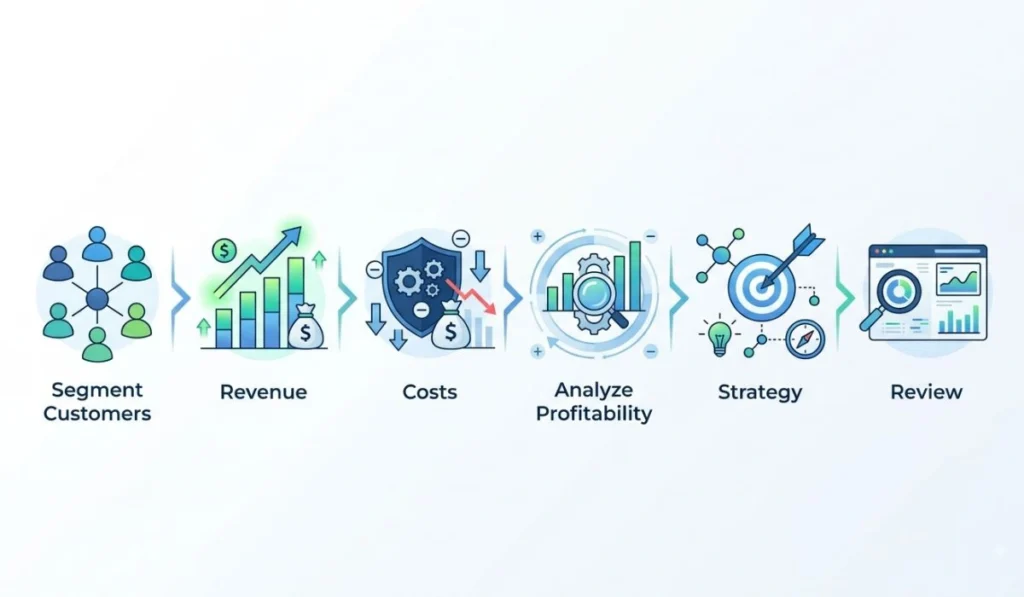
To do a Customer profitability analysis, you need to follow a certain approach. The key is to segment the customer base, determine revenues, attribute costs and also have an activity-based costing approach. Let us know all the steps in depth here.
Segmenting Customers
The base for a profitability analysis is customer segmentation. This will differ across industries and companies. It can be demographic- based on customer age, income, area, etc. It can also be psychographic that is based on customer needs, behaviours, values, interests, and attitude.
Revenue Attribution
Once segmentation is done, you need to calculate revenue for each segment. The annual revenue is a sum of all segments. Adjustments like discounts, fees, service charges must be included and adjusted accordingly.
Cost Attribution
Calculate the annual cost per segment. This will be customer costs, service costs, product costs, sales, marketing, and distribution costs. These costs are usually hidden and need to be added to determine the cost attribute.
Analysis – Profit, Less Profitable, Unprofitable
Profitable customer segmenting also requires analysis of segments. Classifying those segments that have better revenues over costs is necessary. It must include calculating profitability over the lifetime of customers.
Develop Strategies to Maximise Profits Based on a Focus on Specific Segments
The next step is to create strategies that increase revenues, create long term relationships, and enhance customer retention and loyalty programs. Strategies can include elimination of least profitable aspects, re-engineering customer groups into profitable ones by increasing revenue and decreasing costs.
Review the Impact
Any new strategy or practice needs to be implemented and worked up accordingly. This needs to be reviewed after appropriate periods of time to understand impact on customers.
Mistakes Made While Performing Customer Profitability Analysis
While performing customer profitability analysis, it is necessary to track some mistakes. If you know these mistakes in advance,you can avoid making them. Customer profitability analysis allows you to spot long-term customers, identify buyer habits, and improve targeting towards customers.
To calculate customer profitability, you need to track customer behavior and activity. The market is, however, subject to changes and different resources. All this makes it necessary to reduce errors in calculating customer profitability as much as possible.
Assuming Every Product is the Same
Customer profitability analysis requires you to assume every product is different. One mistake often made is not accounting for the difference in products. If you assume that all products are equal, it leads to varied impacts. You must keep all differences in mind to measure the right impact. In multi-product enterprises, it is tougher to ascertain the impact of a specific product. However, calculating customer profitability in the right manner drives improved customer retention.
Not Taking into Account all the Costs Involved
Sometimes while calculating customer profitability, one might forget other costs involved. It is easy to forget all the costs involved in the business. If you don’t track these costs, it will reduce the overall profitability. Costs in any company can include sales costs, marketing, transportation, handling, warehousing, and more. These costs might sometimes be omitted from the equation.
Calculating Profitability in Terms of the Customer Instead of Product
Customer profitability analysis can go wrong if it’s calculated only at the aggregate customer level, without breaking down which products or services that customer actually uses. For example, a customer might look profitable overall, while one product line they use is quietly losing money and another is subsidizing it. To get an accurate picture, profitability should be measured both by customer and by the product mix within that customer’s account, not customer profitability replaced by product profitability, but the two used together.
Selecting the Incorrect Time Frame
While conducting the customer profitability analysis, it is necessary to pick the right time frame. The time frame needs to be long to enhance results. This helps since you get the right picture of the customer’s lifetime value. The time frame needs to cover the aspects of product usage. If you include a short time frame, you cannot be sure if the customer underwent product adoption or not.
What Should Be Done to Improve Customer Profitability Analysis
Customer profitability analysis helps determine which customers are in the profitable bracket. It helps improve businesses to include customer satisfaction, value, and market share. Customer profitability helps track potential trends so that businesses can be steered that way. You can also decide on better pricing strategies for the business. Customer profitability analysis, if done right, allows matching customers with better-performing customers to draw insights and offer targeted content.
Here are a few things you can do to make your customer profitability analysis more efficient
- Account for expansion and renewal revenue.
- Maintain accurate customer-level data: Faulty data will inevitably result in faulty and untrustable results.
- Integrate CRM, billing, support, product usage, and Customer Success data: avoiding data silos and integrating the necessary data can help you see the bigger picture more clearly. You will be able to find the true profit.
- Review profitability periodically: CPA is dependent on many factors that are subject to periodic changes, so periodic reviews become necessary to avoid outdated data
- Track changes in customer behaviour and service costs.
- Compare profitability across customer segments: Profitability does not remain the same across customer segments
Conclusion
You can extend the usefulness of CPA by continuous review of customer profitability. It should not be treated as a one-time exercise if you want it to be effective. Customer Success platforms and analytics should collaborate periodically to help businesses make more informed profitability decisions. Data-driven decision-making leads to better long-term growth, provided that data collection is meticulous and the collected data is accurate.
Frequently Asked Questions
Customer Profitability is a method to calculate the profitability of a certain customer or customer segment across a specific period of time.
The formula for calculating customer profitability is CPA = Total Revenue from a Customer -Total Cost to Serve that Customer
Customer lifetime value only focuses on overall revenue and net profit is concerned with the overall profit. There is no other method to calculate the profitability of customer/customer segments individually.
All kinds of direct and indirect costs, customer support costs and maintenance cost of customer success should all be included in the customer profitability analysis for accurate results.
Customer lifetime value gives you the overall revenue an average customer generates during their entire relationship with a business while customer profitability gives you the profitability of a certain customer or customer segment across a specific period of time.
Experts recommend that customer profitability should be reviewed at least once every quarter.
Customer success is the prime factor that turns a one-time sale into a profitable recurring business relationship.
Ultimately, the customer with higher lifetime value will be the most profitable.