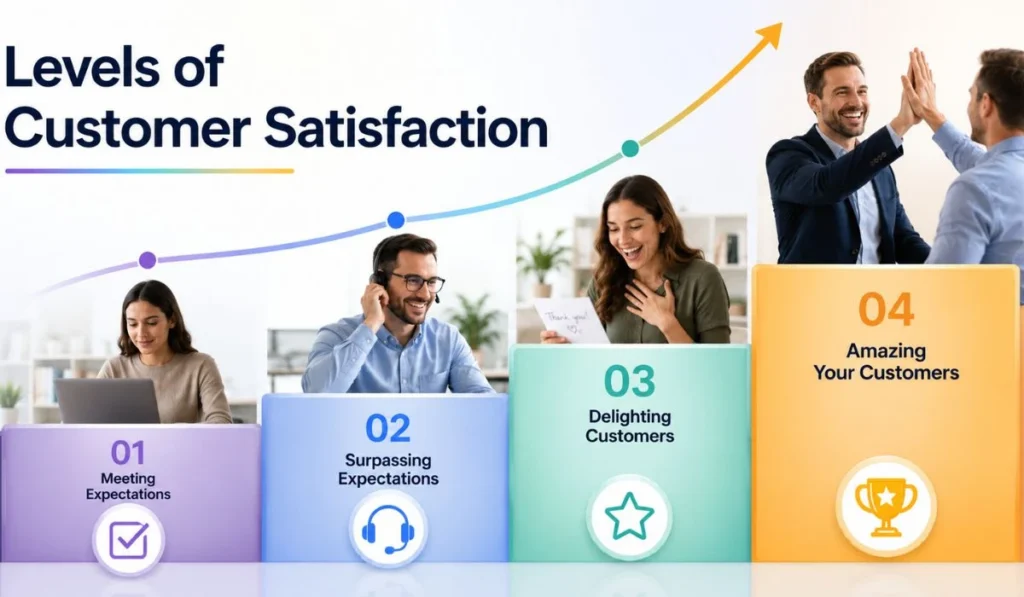


Customer delight is about meeting customer expectations and exceeding them. It goes above and beyond providing good service and customer experience. The key to doing that is by making sure customers understand your value.
Keeping customers engaged in the company and its offerings is often difficult. They need to be brand advocates who ship for you and drive long-term growth. Many businesses now use dedicated and researched customer delight strategies to improve loyalty, retention, and customer advocacy.
Customer delight has become a requisite in the business world. Customer experience and customer delight are non-negotiable due to the prevalence of multiple options for customers. If a customer is not happy with you, they can simply churn to another brand that will offer them the right experience.
This article covers customer delight from aspects like strategies and how to measure it, and also discusses a few examples.
What is Customer Delight?
Customer delight can be defined as meeting customer expectations, surpassing them, and ensuring that the customer feels a positive experience with the product or company. It is essentially an emotional response created when a brand exceeds expectations.
Common areas one can focus on to improve customer delight include personalization, convenience, proactive support, and creating unexpected value.
Customer Delight vs Customer Satisfaction: Understanding the Difference

Customer delight and customer satisfaction are related but distinct concepts. What we call customer satisfaction generally (and throughout this article) is concerned with meeting basic customer expectations. If we were to classify customer satisfaction as four levels, meeting expectations will be the first. Customer delight, on the other hand, involves exceeding customer expectations and creating a positive experience for the customer.
The major differences between customer satisfaction and customer delight are their objectives.
| Customer Satisfaction | Customer Delight |
| Meeting customer expectations Solving customer problems Providing reliable service | Exceeding customer expectations Creating memorable experiences Building emotional connections |
Customer satisfaction can help you retain customers by meeting their basic needs. But customer delight can encourage deeper customer loyalty. Loyal customers can turn into staunch advocates for your organization.
Steps to Reach Customer Delight
Communication keeping the customer in mind
Communication is key. Whether during the onboarding process or providing feedback, proper communication with the customer is essential to reach customer delight
Gaining a competitive advantage
If your product/service pales in comparison to your competitors, you can never reach customer delight. You have to provide more than your rivals can.
Meet evolving customer demands
Merely meeting customer expectations isn’t enough. Customer needs evolve with time and industry trends. Be prepared to evolve with them and deliver their demands.
Offer a timely positive experience
Your window of opportunity to reach customer delight may not always be long enough. Prepare and start executing your customer delight strategies on day one.
Understanding customer needs
Your customer delight strategies should directly address customer needs. Without understanding what they want, you cannot provide them the positive experience that leads to delight.
Personalizing interactions
Impersonal interactions feel inauthentic and can have a negative effect on building customer relationships. Add personal touches to your interactions
Creating consistent experiences
Creating a one-off positive experience is not enough. Customer delight requires you to consistently exceed expectations and create positive experiences.
Acting on customer feedback
Use customer feedback tools and metrics effectively. They can provide valuable insights into customer needs and expectations and also help customers feel heard and valued (provided that you conduct feedback regularly and follow up with necessary actions).
Anticipating customer problems
Anticipating and fixing customer problems before they raise a ticket or have to bring the matter to your attention is important. This way you actually exceed customer expectations instead of just meeting them.
Customer Delight Strategies Businesses Can Use
Now that you know the difference, let’s check out the various customer delight strategies businesses use.

Personalized customer interaction – Instead of a one-to-many mode of interaction, use customer segmentation to find clients who have met basic expectations and personalize interactions to guide them to delight
Offering proactive support – Don’t wait for support tickets to be raised. Find out issues where support is needed with collected data and proactively fix them
Responding quickly to customer needs – Time is of the essence. If a customer raises a ticket or expresses a need, respond promptly to reassure them that it will be fixed quickly. Unresponsive or slow customer service is detrimental to any business
Using customer feedback to improve experiences – Don’t turn customer feedback into a mere data collection tool. Use it to enhance customer experience by listening to them.
Providing educational resources – Proper educational resources increase product knowledge, which in turn leads to faster value realization. You cannot delight a customer if they don’t fully understand your product’s capabilities
Simplifying customer journeys – Simplify customer journeys by executing your customer delight strategy in a way that leads to reduced customer effort.
Customer Delight Examples
Customized Customer Experience
Hindustan Pencils Private Limited is a popular pencil company in India. A mother once wrote to the company regarding how her child had difficulty using their sharpeners. Her daughter was left-handed, and thus the sharpeners were tough to use. The company responded in a manner that delighted the customer.
Action: The brand customized the experience for the customer as much as they could
Why it works: Customer feels understood and valued
Lesson: Personalization can encourage customer loyalty, and increased loyalty helps customer delight
Connect with them on special occasions
The most important aspect in customer delight is using the right occasions to make a mark. Birthdays, festivals, special days, etc. are all great to make customers feel loved. Customer delight strategies on birthdays or special occasions give them a chance to strike a positive emotional chord.
Action: Sending emails, sms, etc. on special occasions like birthdays, festivals, and special days
Why it works: Develops a personal and emotional connection with the customer
Lesson: Customer delight requires a deeper emotional connection with the customer than basic customer satisfaction.
Try handwritten notes and messages
A handwritten note is a terrific way to show that you care. You can show the effort and time that the company has taken to make the customer happy. Gratitude marketing and personalized responses can help drive repeat business.
Action: The UK-based women’s activewear company called Sweaty Betty sends its loyal customers handwritten thank-you notes.
Why it works: The act humanizes the brand and sets it apart from impersonal commerce, fostering deeper customer relationships.
Lesson: Setting your business apart from competitors with personal touches like handwritten notes goes a long way in achieving customer delight
Build trust
Building trust is a fantastic way to ensure customer engagement. It cannot be built overnight. Transparent and proactive communication, keeping your promises, and protecting customer interests are a few ways to get customers involved with the brand and build trust.
Action: A brand provides helpful educational content about the product without trying to sell it.
Why it works: Customers tend to trust brands that focus on product education more than promotion
Lesson: Trust is the cornerstone of any healthy commercial relationship
Run contests/competitions
A competition based on the product, or a simple social media caption contest, can improve customer engagement considerably. It can delight customers if they win the contest.
Action: Camera brands like Nikon and Sony regularly sponsor and/or conduct photography contests and competitions
Why it works: Contests and competitions foster user engagement through user communities
Lesson: Contests and competitions are great ways to encourage customer engagement, which can aid customer delight
Try to reduce dissatisfaction
If you know what could lead to customer dissatisfaction, you can reduce that. It could be the messaging, tone, or the delay in response that is troubling customers. If you can understand the issues customers are facing, you can work out a strategy to resolve them. Instead of waiting till your customer calls your service team, you must try to anticipate the issues on your own. Saying sorry and thank you go a long way in making an experience valuable for customers. Ask them what is wrong and suggest action points accordingly.
Action: A SaaS company proactively fixes software issues and sends apology emails to all customers. They also include a questionnaire to identify other such issues
Why it works: Customer delight is about exceeding expectations and delighting the customer. By identifying and fixing a problem before it can cause dissatisfaction, you can protect customer delight
Lesson: Reducing dissatisfaction is an integral part of customer delight
Engage on Social Media
Social media is an incredibly powerful tool for customer satisfaction and delight. Many reputable brands use social media to improve their customer relationships. Quick response times on social media can show your customers that you care. Moreover, every interaction on social media can be turned into a relationship-building opportunity and foster community engagement.
Action: Jason Cohen, the founder of WP Engine, hosted Reddit AMAs (Ask Me Anything) sessions in niche subreddits
Why it works: Reddit is a social media platform that can directly connect B2B brands with its audience
Lesson: Social media engagement can drive better customer relationships
Take Feedback Seriously
Many companies use feedback as mere data collection to check columns in a corporate checklist. In these cases, customer feedback does not drive operational changes. This can have adverse effects on customer delight. Take feedback from customers seriously and execute actions and changes that can be productive.
Action: A company receives feedback related to its customer service response time. Without missing a beat, they reorganize their team to reduce response time.
Why it works: Listening to and acting on feedback lets the customers know that you prioritize them above all else
Lesson: Feedback data can help you achieve customer delight if you take them seriously.
Keep Solutions Easy
Do not complicate your operations unnecessarily. Requiring increased customer effort towards product adoption can negatively affect customer delight. Keep your onboarding process simple and provide easy self-service options. Clear and transparent communication can reduce complexity and thus customer effort.
Action: A company provides clear onboarding assistance, instructions, and multiple educational self-service options. Their customer service strategy is based on reducing customer effort
Why it works: “Path of least resistance” applies here. Customers will always prefer simple, easy solutions to complex, difficult mechanisms.
Lesson: Customer effort has a strong influence on customer delight
How to Measure Customer Delight
You have done all you can to delight your customers. Now comes the time to measure it. The top metrics to measure customer delight are NPS or net promoter score, CSAT or customer satisfaction, CLV or customer lifetime value, and customer churn.

Net Promoter Score (NPS)
Net Promoter Score, or NPS, is a survey-based metric that measures customers’ willingness to recommend your product/brand to someone else. A high NPS suggests that the customer is delighted with your product and service enough to advocate for you.
Customer Satisfaction Score (CSAT)
CSAT is a metric that measures customers’ happiness with your product, service, or interaction based on survey scores. A high CSAT is to be expected when you reach customer delight
Customer Lifetime Value (CLV)
Customer Lifetime Value is the net revenue or profit a company expects to generate from a customer. Higher CLV means higher customer loyalty and reduced churn rate.
Customer Retention and Churn Rate
Customer retention refers to your ability to do two things:
- Turn new customers into loyal repeat customers
- Keep existing customers from dropping your product/service for alternatives
Churn Rate refers to the percentage of customers that unsubscribe to/stop using your product or service.
The goal of any standard business is to keep customer retention high while keeping churn rate low. Customer delight can influence customer loyalty, leading to repeat purchases and recurring revenue. It can also reduce churn rates.
Bottom Line
To enhance customer delight, customer feedback is the key. You need to engage on social media, surveys, email campaigns, and website forms to know if the audience is interested. Customer delight helps you create a positive customer experience and vice versa. You need to create an omnichannel experience that works across departments and customer stages to meet and exceed customer expectations.
Frequently Asked Questions
Customer delight refers to the state of delight a customer experiences when a company/product/service exceeds their expectations and provides a positive experience.
Basic customer satisfaction is concerned with meeting customers’ expectations, while customer delight is concerned with exceeding customer expectations to provide them a positive experience.
Customer delight is important for businesses because it has a huge impact on factors like customer loyalty, retention, and churn prevention.
Customer delight strategies include personalized interaction, proactive support, quick responses, providing educational resources, etc.
Companies can measure customer delight using metrics like Net Promoter Score (NPS), Customer Satisfaction Score (CSAT), Customer Lifetime Value (CLV), Customer Retention Rate, and Churn Rate.
Customer delight can influence customer loyalty. Customer loyalty, in turn, can influence customer retention.