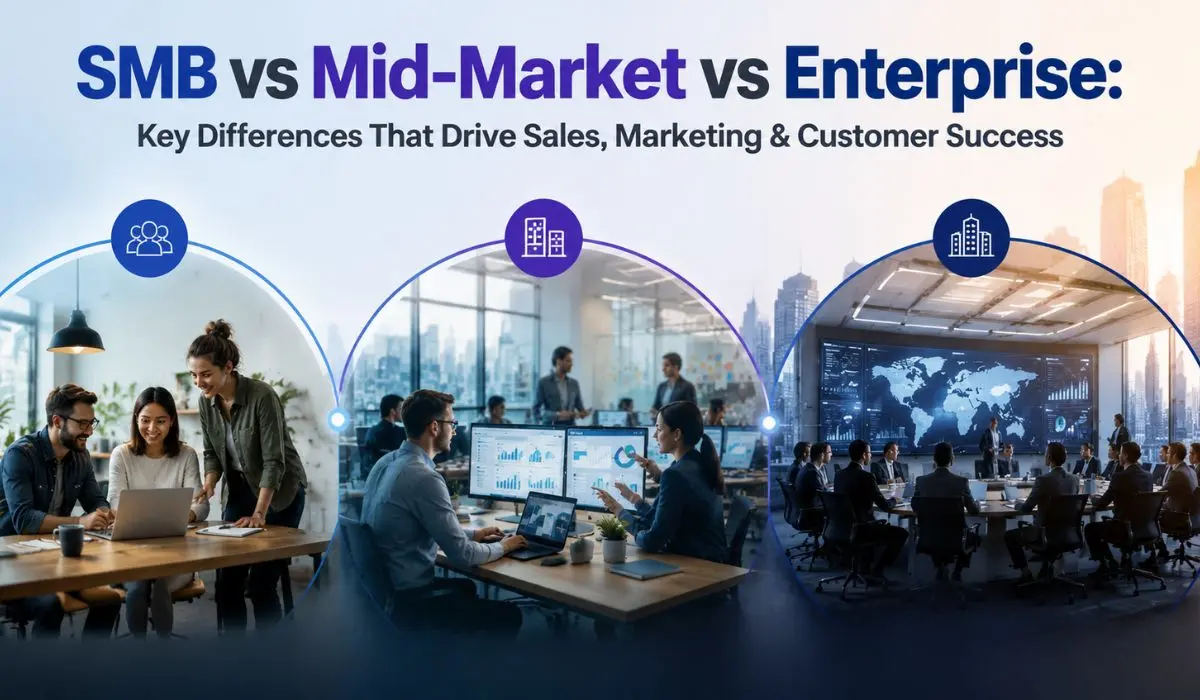


Every customer that uses the same product need not be identical. Each may have their own individual goal in using a certain product. Similarly, enterprises and SMBs have different strategies and goals. Though there are several common key characteristics, there are specific differences one needs to keep in mind while dealing with small, medium-sized, mid-market, or enterprise businesses.
SMB (small-to-medium-sized businesses), mid-market, and enterprises are different B2B customer segments. Their goals and strategies are different from each other, primarily due to the difference in scale among them.
SMBs are companies with fewer stakeholders. They have lower yearly sales, budget, and employees. Their decision-making processes are much quicker than the other two customer segments.
Mid-market companies are bigger in size compared to SMBs. They have improved budget, scale, and number of employees. Their decision-making process is more structured.
Enterprises are massive in scale, budget, and number of employees compared to the other two segments. They have a huge number of stakeholders. Decisions are carried out by dedicated committees
This blog explores the differences among SMBs, mid-market, and enterprise customer segments across sales, marketing, and Customer Success.
SMB vs Mid-Market vs Enterprise: Key Differences
The differences between SMBs, Mid-market, and Enterprise businesses are often misunderstood. More often than not, only the scale of the business is considered before grouping a business into one of the three. The table below shows different factors that affect a business’ classification. Keep in mind that this classification is not universal. It can vary between companies, industries, and segmentation models.
| Factor | SMB | Mid-Market | Enterprise |
| Organisational complexity | Low | Moderate | High |
| Buying process | Fast | Comparatively slower | Very slow |
| Number of stakeholders | Low | Moderate | High |
| Sales cycle | Short duration | Medium duration | Longer duration |
| Budget/deal size | Low/small | Medium | Huge |
| Procurement | Fast | Slower | Very slow |
| Security/compliance | Minimal | Moderate | Heavy |
| Implementation | Easy | Slightly demanding | Extremely complex |
| Customer Success model | Self service/low touch | Hybrid | Strategic/high touch |
| Support expectations | Low | Moderate | High |
SMB
- Fewer stakeholders: Fewer stakeholders usually means less stalling time. The decision-making process will be sped up.
- Simpler evaluation: The buying process of an SMB is usually driven by immediate problem-solving intention, which simplifies the evaluation process. Mid-market to large enterprises usually have more bureaucracy involved, which will extend the process
- Price/value sensitivity: Price/value sensitivity is high in SMBs compared to the other segments. They look at immediate value and monthly expense due to their small scale
- Shorter approval process: Since the decision-making authority will be more concentrated than other business sizes, approvals occur faster
- Ease of implementation: The sheer scale of enterprises and medium-market businesses makes implementation a heavy task. It is comparatively easy in SMBs
- Fast time to value: SMBs’ time to value (TTV) usually takes days, hours, or minutes, while enterprise TTV takes months or quarters due to heavy complexity.
Mid-Market
- Multiple stakeholders: Decision-making time will be higher compared to SMBs due to the increased number of stakeholders
- Stronger ROI evaluation: They have finite resources compared to enterprises and cannot rely on informal ROI tracking like SMBs. They need real data and software tools to track resources and return.
- Integration requirements: They do not have extensive integration requirements like enterprises. Integration of necessary tools needs to be customized to fit the specific needs of the organizations (like custom workflows)
- Greater product scalability requirements: Mid-market organizations require products that scale at a faster rate than SMBs but with less complexity than enterprises. They need to be able to adapt to sudden user growth.
- More structured approval/procurement: Procurement occurs at a moderate speed compared to SMBs and enterprises. It requires more speed than enterprises and more control than an SMB.
Enterprise
- Buying committees: In a large enterprise, dedicated buying committees are formed with stakeholders across different departments to handle purchases. It is very structured and formal
- Procurement: Procurement speed in an enterprise is much slower than in mid-market and SMBs. Authorization for purchases must come from different levels of the organization.
- Security assessment: Enterprises have improved security assessments compared to the other two due to their proneness to attacks. They also have better budget allocation for security assessments
- Legal/compliance review: Legal compliance requirements for enterprises are much more demanding than SMBs or mid-market organizations. They handle a massive amount of regulatory requirements across several jurisdictions at once.
- Integrations: Integration requirements for an enterprise are massive compared to SMBs and mid-market companies. It requires a higher level of customization, extensive security reviews, synchronization across multiple cloud services, and compatibility with legacy systems, to name a few.
- Implementation planning: Implementation planning is a tremendously time-consuming process in enterprises. It can take anywhere from 12 to 36 months on average. It is handled by dedicated formal governance spanning large steering committees and project management offices.
- Executive/business approval: Business approvals take much longer compared to SMBs and mid-market companies. The exact duration of a buying cycle largely depends on the enterprise, but it can run long.
Presentation or Demo Process
Pitching to every customer category is difficult. It requires teams to take up a calculated process that gives the desired results. Small businesses need to act based on the choices they have. In some cases, they may not have a lot of budget associated with a product. This leads to pitching in terms of cost-effectiveness. Another aspect is that in small businesses, they may not be able to schedule a call or reply since they will have limited resources and time. They would probably choose a product after careful consideration. Enterprises expect a polished demo and presentation, which will take multiple calls and meetings to finalize.
| Customer Segment | Effective Presentation/Demo Choice |
| SMB | Scalable/self-service or standardised demos |
| Mid-market | More tailored demonstrations |
| Enterprise | Customised demos (involving multiple stakeholders and technical/business requirements) |
Sales
Enterprise sales are ones that involve higher ticket sizes, risks, and longer sales cycles. SMBs mostly purchase for self-usage, slightly smaller sales cycles, and transactions. The number of decision-makers involved with SMBs and enterprises is also different. There are usually more decision-makers if the deal is large. At other levels, the purchasing decisions are guided by price and the need of the individuals. Sales reps need to find relevant spots and strategic aspects to improve aspects of the purchase. SMBs will be facing lesser pressure as compared to enterprise companies. Enterprise sales can even take up to a year to see the light. Sales for enterprises have multiple processes and involve high-level buyer and seller involvement. There is a lot of involvement and engagement at various levels from SMB reps.
Content
Every company differs in terms of what content formats they would prefer or consume. The purchasing habits of SMBs are primarily influenced by pricing pages, reviews, demos, tutorials, and peer recommendations. Case studies, ROI information, product comparisons, and integration documentation are the deciding factors for mid-market buyers. Enterprise buyers, on the other hand, rely on extensive case studies, business cases, security documentation, implementation information, technical documentation, and executive materials to formulate their purchase decisions.
Content is necessary to spruce up a brand and establish a rapport with the reader. Creating the right content based on buyer segments and niches will help close the deal faster.
Marketing
There is a vast difference in how something needs to be marketed to SMBs, mid-market businesses, or enterprises. The core ethos is more than just the number of employees or the revenues.
Small businesses need more narrowing down when it comes to marketing. They would prefer niche marketing. Their core focus swings between creating demand and scalable acquisition.
Marketing to mid-market demands more personalization than SMBs. Segmented campaigns and sales-assisted marketing might be the winning path for this B2B customer segment.
In contrast to both, larger enterprise-scale companies require broader marketing by segmenting commonalities. Enterprises are more geographically spread and diverse. There is more variety in the audience. Multichannel marketing or Omnichannel marketing will prove more effective in these processes.
Customer Success for SMB vs Mid-Market vs Enterprise Customers
Enterprises, mid-market companies, and SMBs differ in terms of how their customers reach success. Although LTV (lifetime value) largely depends on retention, margins, acquisition costs, expansion, and other factors, enterprises tend to have more LTV due to their resource advantage. They can afford a higher customer acquisition cost and are willing to spend more.
In this manner, how business organizations plan and implement their customer success strategy can vary greatly depending on the size of their business. Let’s take a look at the differences in customer success across the different business sizes.
SMB Customer Success
- Scalable onboarding: SMBs usually have a dedicated scalable onboarding framework they use for all new customers.
- Digital/tech-touch engagement: Due to their affordability, SMBs largely prefer to use automated tools, self-service portals, and data insights instead of human teams for customer lifecycle engagement.
- Knowledge bases: SMBs typically use shared folders and notes for their knowledge bases.
- Self-service: Sometimes, SMB onboarding can be entirely self-service and extremely low touch.
- One-to-many communication: Marketing or other such communications happen in a one-to-many method instead of a targeted and personalized approach.
Mid-Market Customer Success
- Hybrid engagement: Mid-market customer success strategy mixes digital touch with human touch to avail the best of both worlds.
- More personalised onboarding: Compared to SMBs, the onboarding process of mid-market organizations is more personalized and tailored for specific customer requirements.
- Periodic success reviews: Often conducted bi-annually to track ROI (Return on Investment), value realization, workflow barriers, etc
- Product adoption monitoring: Carried out by mid-tier analytics software with product managers overseeing the tracking.
- Expansion opportunities: Mid-market success teams have better expansion opportunities as they have higher revenue expansion per customer than SMBs and lower procurement barriers compared to large enterprises.
Enterprise Customer Success
- High-touch engagement: The higher budgets of large enterprises allow them to use high-touch engagement models involving dedicated managers and personalized onboarding with high-value customers
- Dedicated CSM/account management: Used for heavily customized customer support for high-value accounts in large enterprises.
- Multiple stakeholder relationships: Customer success teams in large enterprises handle larger numbers of stakeholders and decision-makers. This usually means higher friction and slow decision-making.
- Success plans: Success plans in enterprises are massive in scale with extensive long-term implications compared to the other two. It has to align with the interests of multiple stakeholders.
- Business reviews: Conducted every quarter (four times in a year) with multiple stakeholders. It is highly formal with custom metrics to track growth and ROI (Return on Investment).
- Adoption monitoring: Extensive and multi-layered tracking compared to SMBs and mid-markets, which tend to focus on user growth and volume.
- Renewal planning: Renewal planning in enterprises has higher requirements. It requires long timelines, custom value reviews, and many stakeholders.
- Expansion planning: More long-term strategic approach compared to SMBs and mid-market companies.
How to Serve SMB, Mid-Market and Enterprise Customers Effectively
For any company, it is important to consider the buyer or prospect while devising a strategy. For larger deals, it is crucial to expect more incoming revenue and hence different strategies.
To serve enterprise customers effectively, focus on building strategic relationships, managing stakeholders, and prioritizing complex customer requirements.
For SMBs, you need to offer low-touch tech models that have self-service or are easy to use. You must divert your prioritization in the direction of efficiency, simplicity, and scalability.
Mid-market requires a moderate approach. Aim for a balance between scalability and personalization.
This allows you to segment and serve accordingly. Keeping all processes centered around the buyer will enhance overall success rates and streamline the process.
Frequently Asked Questions
SMB (small-to-medium businesses), mid-market, and enterprises are all B2B customer segments. The primary difference is in the company size, but other factors (often stemming from the size difference) include: annual revenue, number of stakeholders, and sales complexity.
Mid-market customers are companies that sit between the small-to-medium business customers and large enterprises. A correct threshold does not objectively exist; therefore, what business is considered mid-market can be largely subjective.
The main difference between an SMB sale and an enterprise sale is scale. Other differences include the number of stakeholders, sales cycle duration, integration requirements, etc
Customer success for SMB adopts scalable onboarding with tech touch engagements, self-service portals, and low-cost automation. In contrast, enterprise customer success involves extensive attention, like high-touch engagement, quarterly business reviews, high-tech adoption rate tracking, and much more.
There is no “one universal law” when it comes to customer segmentation. It is not a concrete classification but a convenient grouping. SaaS companies should consider factors that might affect their business interests when deciding the criteria for the classification.