

The success of any company is deeply tied to the extent of customer satisfaction it can achieve. Each customer will hold certain expectations when they choose to use your product. customer satisfaction measures how well you meet or exceed customer expectations.
From meeting basic expectations to creating memorable experiences, customer satisfaction has a wide range of possibilities. Any business aiming for long-term growth has to land in the higher ranges of this spectrum. High levels of customer satisfaction may not guarantee customer retention or loyalty, but it is a necessary part of both.
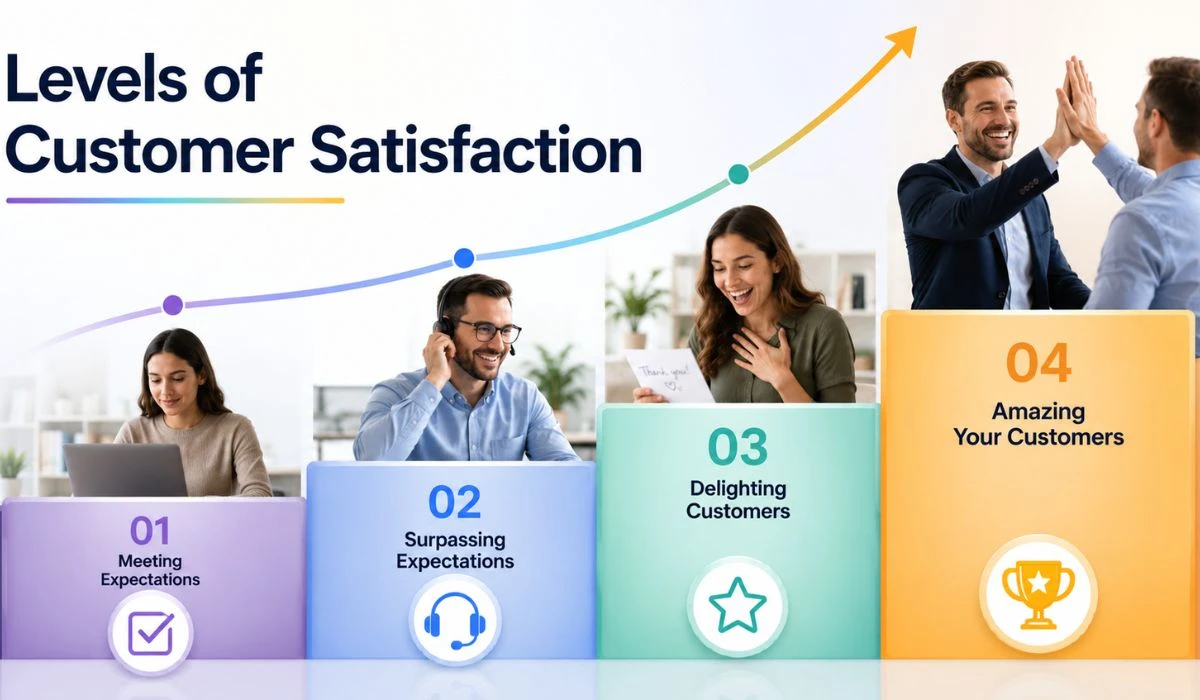
Although there is no universal scientific classification for customer satisfaction, for convenience, it can be divided into four levels or tiers.
Level 1: Meeting Customer Expectations
Level 2: Surpassing Customer Expectations
Level 3: Delighting Your Customers
Level 4: Amazing Your Customers
| Level | Customer Experience | Business Goal |
| Meeting expectations | Basic needs are reliably fulfilled | Remove dissatisfaction |
| Surpassing expectations | Experience goes beyond the baseline | Differentiate the experience from competitors. |
| Delighting customers | Unexpected value creates a positive emotional response | Strengthen preference and loyalty |
| Amazing customers | Exceptional, memorable value is delivered | Build advocacy and deeper relationships |
Level 1: Meeting Customer Expectations
This is the level at which your customer has recognized that your product delivers what they have been looking for and what you promised them. When you meet basic customer expectations, the benefits may not be incredible but balanced. You will start building trust, help reduce early churn, and be able to bring down the acquisition cost.
Practical example: Your micro SaaS company provides an AI Subtitle Generator for content creators. The software performs its primary objective without hassle, and your customers are satisfied with the service.
But meeting basic expectations cannot be enough for a long-term strategy for growth and profit. A competitor that exceeds the customer’s expectations even by a little might gain an advantage over you.
Level 2: Surpassing Customer Expectations
Customer satisfaction at this level has to go beyond basic functionality. You have managed to make your customer realize value in using your product/service. But they might not have tapped into all of the functional features yet. They might still be in the early-to-middle stage of onboarding. At this point, exceeding their expectations becomes a priority to prevent them from being at risk of churn and considering alternatives. You need to shift your emphasis from basic functionality to deliver the following:
- A customer support system that can resolve issues faster than customer expectations
- Proactive onboarding that reduces beginner anxiety
- Relevant product guidance to accelerate value realization
- Proactive communication about problems
- Reduced customer efforts
You will also need to deliver a multitude of additional causes that can give you an edge over your competition. Exceeding their basic expectations will become an important factor in your customer retention rate.
Practical Example: As an AI Subtitle Generator SaaS company, your company creates a product guide that walks customers through additional features such as AI subtitle translation and auto-synchronization.
Practical Example 2: Your company establishes a buddy system to enhance the onboarding process for your newest clients
Level 3: Delighting Your Customers
Delight is a positive human emotion. It is not usually evoked by basic functionality or simply surpassing it. You need to make them experience something that pleasantly surprises them. Right above exceeding expectations, customer delight aims to create a positive experience that nurtures customer relationships and aids customer loyalty. Ordinary satisfaction cannot replicate the same effects.
To delight your customer, you can adopt proactive problem-solving (identifying and solving a problem before the customer reports it), personalized onboarding designed for specific customers, and removing unexpected friction during a critical workflow.
Practical Example: Your AI Subtitle Generator sends a notification when new language input options (or any new feature) are made available.
Practical Example 2: Public Product Roadmap
A proactive and responsive customer support is a huge part of customer delight. Even if the issue cannot be resolved immediately, take the effort to make sure the customer feels heard.
Level 4: Amazing Your Customers
This is the top level of customer satisfaction. By this point, you might have gained considerable customer loyalty, but it will not be sustainable or grow further if your actions don’t match the goals. You have to go beyond expectations and delight to amaze your customers.
If delighting your customer was a way to differentiate yourself from the competition, amazing them is the way to put yourself in a different league. To navigate this level, you not only need to prioritize customer needs but also anticipate them before they arise and proactively fulfill them. The data collected during the previous levels (through feedback, support tickets, etc) is vital in reaching this level of synchronization.
Practical Example: Your customer success team in the AI Subtitle Generator SaaS analyses customer profiles and recognizes that a considerable part of your customer base creates content intended for people with hearing impairments. The procedures to check the viability of the SDH (Subtitles for Deaf and Hard-of-Hearing) feature would begin before any customer raises a request.
Here are some tips to amaze your customers:
- Instead of waiting for support tickets, take necessary measures to help customers navigate through difficult situations and hiccups proactively.
- Proper Service Recovery. It is a process or a series of steps designed to bring back dissatisfied customers by regaining their trust.
- Personalized customer success not only helps you maximize your potential for upsells and cross-sells. It can also make the customer feel seen and heard
- Rather than making a ritual out of customer feedback, follow up with meaningful actions
- When you receive support tickets, look for improvements beyond just immediate resolution
- Deliver unexpected value at a critical point in the customer journey
Customer satisfaction is fundamentally subjective. But that doesn’t mean that it should be inferred from behaviour. It is quantifiable, and businesses need to measure it to determine whether they meet customer expectations.
There are mainly three metrics that measure customer satisfaction.
| Metric | What It Stands For | What It Helps Measure |
| CSAT | Customer Satisfaction Score | Satisfaction with an interaction |
| NPS | Net Promoter Score | Loyalty/advocacy sentiment |
| CES | Customer Effort Score | Effort required to complete a task |
How to Improve Customer Satisfaction Over Time
The basis of the customer success niche is the happiness of the customer. A happy and satisfied customer has the power to promote your brand and elevate your business and reputation. A dissatisfied customer, on top of being a revenue loss by itself, may also affect reputation and acquisition through social proof. Key statistics from a study conducted by the Customer Service/CX Expert Shep Hyken in 2025 suggest that 83% of consumers (US) are more likely to put their trust in a company if they provide excellent customer service. The importance of strong customer support cannot be overstated.
That’s a Wrap
The basis of the customer success niche is the happiness of the customer. The levels of customer satisfaction discussed above show that it is the customer on whom the whole business relies. Satisfied customers can recommend your brand to others, strengthen its reputation, and contribute to long-term customer relationships. And a dissatisfied one can pull down your business. A report by Microsoft backs that up – 56% of people around the world have stopped doing business with a company because of a poor customer service experience.
And you do not have to think of any ‘out of the box’ ideas to fuel this change. Listen to their queries intently. Take up their suggestions and in due course of time, implement them in your system. This will stand as proof to your customers that their recommendations are being valued. You should also follow up with dissatisfied customers, understand what went wrong, and take meaningful steps to resolve their concerns.
Would you just let a customer churn away permanently due to some misunderstandings? Reach out to the agitated customer and figure out what went wrong. Not just that, ensure how can you mend your ways and resolve their issue. Who knows, your simple act of generosity could convert a nearly churned away customer into being a loyal, satisfied, and happy customer who is here to stay with you.
Frequently Asked Questions
The four levels of customer satisfaction include:
Level 1: Meeting Customer Expectations
Level 2: Surpassing Customer Expectations
Level 3: Delighting Your Customers
Level 4: Amazing Your Customers
Customer satisfaction has four levels. The highest level, or the fourth level, is “Amazing Your Customers”.
Basic customer satisfaction refers to meeting the expectations of customers in a business. Customer delight, on the other hand, occurs when a business goes beyond those expectations and pleasantly surprises the customer.
Customer satisfaction can be measured using three different metrics. CSAT (Customer Satisfaction Score), NPS (Net Promoter Score), and CES (Customer Effort Score).
A SaaS company can improve customer satisfaction by preparing the customer success and customer support teams to be proactive in their operations.
High customer satisfaction does not necessarily guarantee customer loyalty, but it is one of the major catalysts in encouraging customer loyalty.