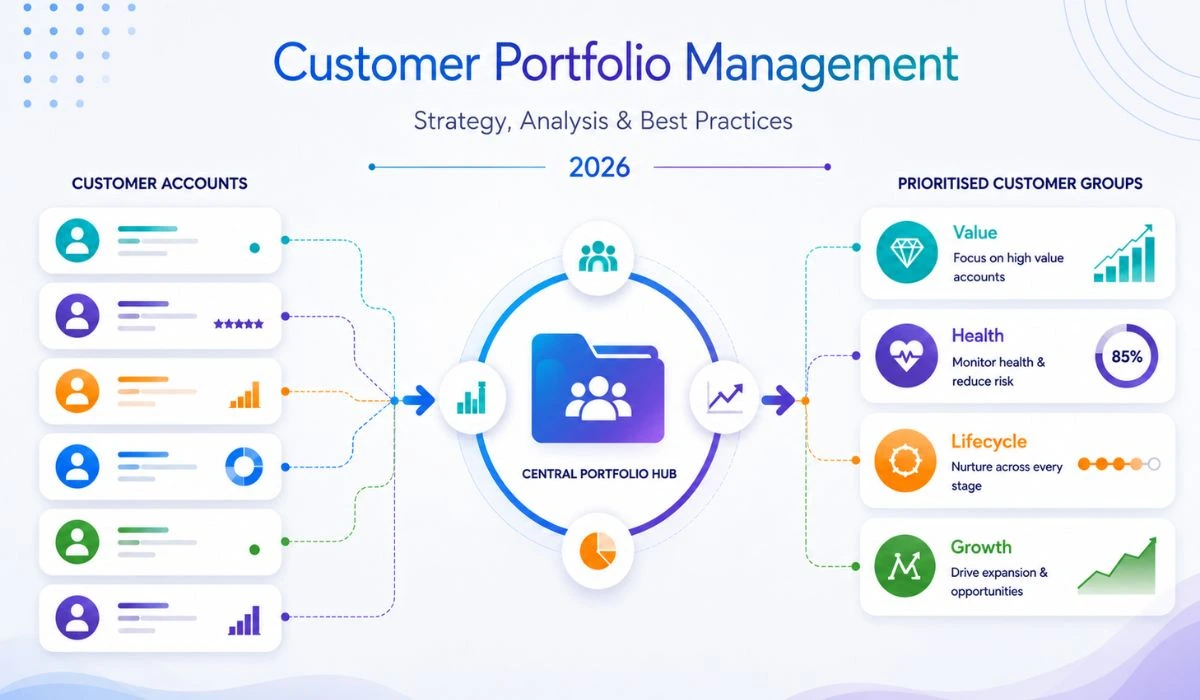


A customer portfolio consists of all the details you need to maintain a relationship with your customer. Through this, you are able to know your customer well and engage with them effectively. Customer portfolio management is done through tools like ERP, CRM, or customer success software that collects and stores all the customer data at one central location.
It helps Customer Success (CX) teams understand, prioritise, and manage customers more effectively. An effective Customer portfolio management can support retention, expansion, and long-term customer success.
The details associated with customer portfolio may include:
- Company’s name
- Point of contacts and associates
- Industry and domain
- Products or services being used
- Ticket size, average revenue and billing information
- Type of relationship
- Potential upsells or cross-sells opportunities
- Customer Health Score
- Renewal dates
- Product adoption
- Customer goals
- Customer journey stage
- Executive sponsors
- Success plans
Clearly, you can see how important it is to give you an overview of the customer. But there’s more to it. This blog will deepen your understanding about customer portfolio analysis, segmentation, prioritisation, and practical customer portfolio management strategy.
Importance of Customer Portfolio Management
Once you get all the details of the customer through their portfolio, you can use it for different purposes which are:
Effective Engagement
Imagine engaging with a client of whom you don’t have the complete information and you go clueless on some obvious point in the meeting, it would taint your reputation drastically. Instead of looking for the information all over the place, you can refer to the customer portfolio before meeting them and know everything you need to hold a meaningful conversation with them. Once you have a clear picture of who the main contacts are, what industry they belong to, what potential for business expansion do they hold, your engagement would be as effective as it can get.
Prioritization of Customer
You can not serve everything to everyone. You need to prioritize your customers for the amount of time and the level of service you can provide to them. To decide who goes first and who stands last, you need to refer to their portfolio and prioritize them accordingly.
Creating Headspace
Based on the portfolio, you can also know which are the customers that are not adding any value to your business. You can discard them straight away which would allow you to create more headspace for serving valuable clients.
How to Do Customer Portfolio Analysis
Customer portfolio management is more than just collecting the basic information of the customer. Lot of criteria fit in while analyzing the customer portfolio which are:
Type of Customer
The type of customer is crucial for you to know to perform your customer success management activities. Few types are:
- Partnership: This is the setup when a customer is more than just a customer. They show immense desire in the growth of the company, product or service. Companies acknowledge their contribution by giving them extra benefits while also growing the revenue from them.
- Recurring: This is the most common type of customer you would find in a subscription-based business. Customers pay you at specific intervals for continued usage of your product or service.
- Occasional: These customers show up once in a while, yet they hold a place in your customer database. Obviously, for such customers, your priority would be lower.
- At-risk: These are the customers who are on the brink of getting churned. You would need high-priority proactive measures to engage with them for retention.
Customer Profitability
This is another criteria for customer knowledge management – how profitable they are to your business. Know that profitability doesn’t solely depend on ticket size. The level of service needed to retain them is equally important. Out of the three categories of low, medium and high profitability, sometimes a medium size customer with no support required is more beneficial than a high-sized customer requiring extensive service.
By Revenue
This is the clear-cut way of analyzing the portfolio. The revenue they generate annually or monthly and the percentage of their contribution on your total ARR also hold importance in serving them. This comes under the category of recurring revenues.
Another category of revenue can be calculated based on customer lifetime value. Based on customer profile, a lifetime value can be projected which helps companies to meet their needs and decide the level of service they would give.
Final category of revenues is through potential upsells or cross-sells opportunities a customer holds for a business.
By Geography
Geography also plays a crucial role in strategizing for customers. Your customers might be spread across different states, countries and in the world. Different criteria like government policies, climate conditions, and business environments add up to the strategies you would create for serving those customers from different locations.
Customer Activity
Based on customer activity also you can segregate their portfolios. Customers who are active or passive need different levels of engagement and hence must be identified beforehand.
Customer Health Score and Portfolio Prioritisation
Customer Health Score refers to a predictive metric that predicts the likelihood of a customer’s future behaviour: whether they will retain, upscale or churn (drop their subscription).
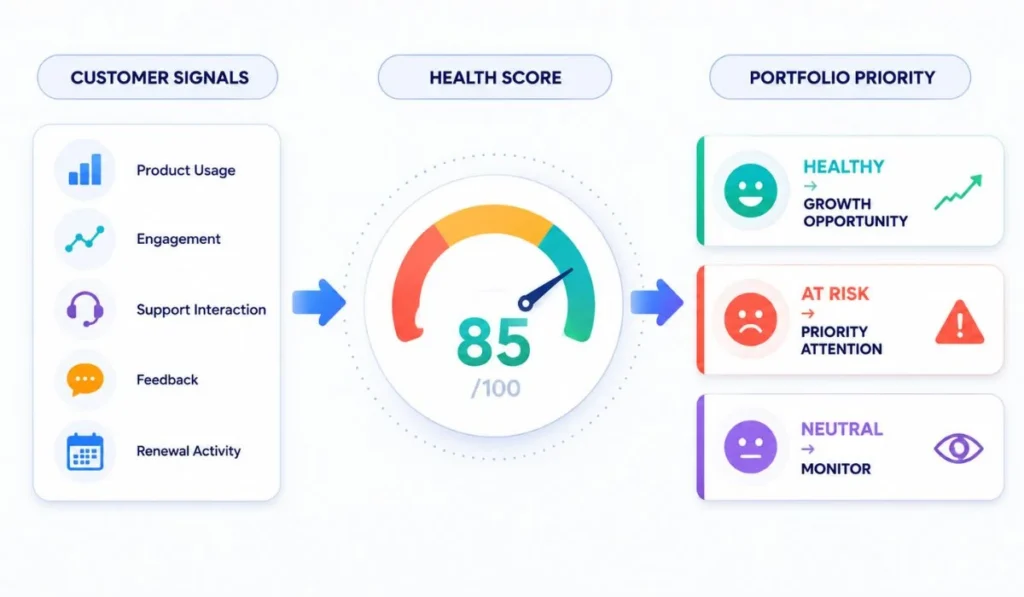
Customer Health Score can help you find possible high churn risk customers and plan your strategy accordingly. You can also use the score to detect when the customer engagement is at the healthiest for expansion possibilities like upselling and cross selling.
A Customer Health Score primarily depends on data like a customer’s product usage, support tickets raised and feedback. Other health indicators include:
- Product adoption
- Feature usage
- Login frequency
- Support tickets
- Customer sentiment
Customer Success teams rely on Customer Health score to decide the priority level of Customer Portfolios.
Business or Industry Type
This is one of the main aspects of segregating the customer – based on their business domain or niche. Customers belonging to a particular niche must be assembled together and the right personnel must be assigned to serve them who possess domain knowledge. Knowing the customer domain is important because it allows you to provide them contextual solutions while also creating the right product-market fit. When you are segregating customers according to their niche, you are opening up to the new verticals of businesses.
Customer Portfolio Management Best Practices
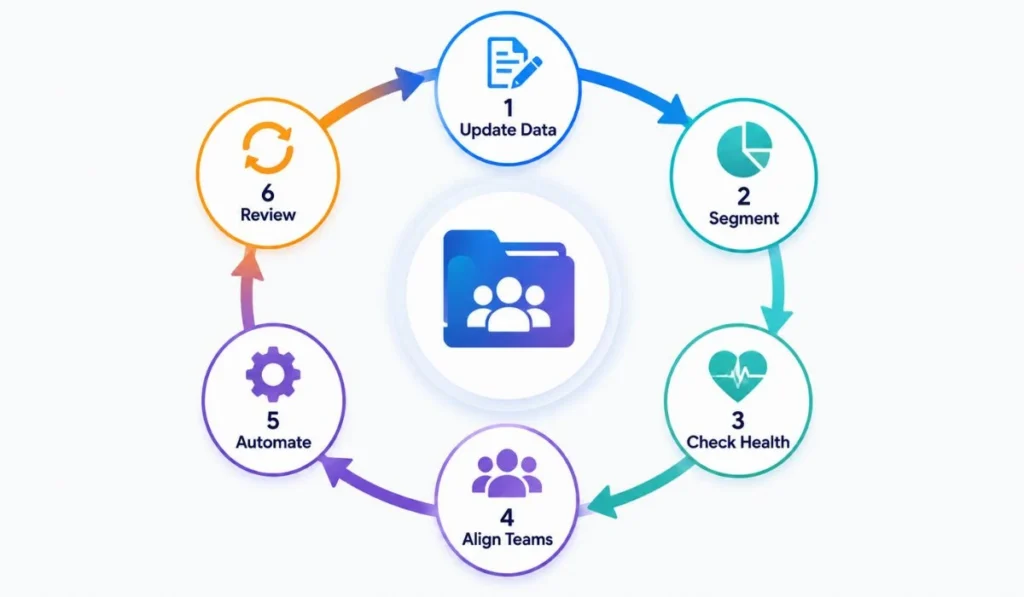
- Keep customer information updated: Customer information is subject to large and small changes like organizational changes and leadership changes. It can affect their subscription pattern.
- Regularly review customer portfolios: Regular reviews can help you spot warning signs like usage drops early and adjust your strategy accordingly. It can also help you recognise growth opportunities.
- Use customer segmentation effectively: Customer segmentation is an effective way to interact with your customers compared to treating them all the same. Grouping customers with similar patterns together can help you personalize your service, reduce usage drops, increase upselling and cross-selling possibilities, etc.
- Monitor Customer Health Scores: Customer Health Score tells you if a certain company is likely to renew, expand or churn. It is a predictive metric used by businesses and monitoring it can produce retention and expansion possibilities.
- Align Sales and Customer Success: Sales try to bring in new customers and upsell to existing customers, while Customer Success is focused on retention and realising value. Aligning both can prevent customer churn due to a lack of coordination (Eg: Sales pushing an upsell while CX is trying to retain and avoid churn).
- Automate repetitive portfolio updates: Reduce time wastage by automating simple, low-risk updates of customer portfolios. It will deliver higher accuracy and free your team to focus on more valuable work.
- Review portfolios continuously instead of once: An occasional one-time review may not be able to spot early warning signs of a churn as effectively as continuous review.
How to Expand Your Customer Portfolio to Gain an Advantage for Customer Success?
Software is frequently bought, used for a year, and then becomes shelf ware the next year. Although it pains us as software manufacturers to believe that the things we worked so hard to create will ultimately turn out that way, it is the case.
Therefore, as a digital marketer, can you contribute to averting this terrible outcome for your product? Promote client success in all facets of the business.
This directly relates to upgrade or renewal plans in marketing, as well as customer success activities. The chance is substantially bigger.
As digital marketers, we have access to so many additional platforms through which we may spread different messages.
Communities and forums are useful for assisting users of the items, but we may concentrate on the chance to diversify the portfolio to foster ongoing success.
Here are some of the steps to get started:
Integrate your Customized Tool with your Customer Data
You may easily segment your audience based on profile and behavioral data by linking your marketing automation system (MAS) or customer relationship management (CRM) system with your preferred personalization solution.
Choose the User Group you Want to Target
This will make it possible to communicate a more meaningful message.
Analyze the Traffic Patterns of the Intended Audience
This will reveal what matters to your customers, where they spend the most time, and how to get in touch with them.
Create your Message with a Clear Call to Action to Increase Interaction
This is a fantastic chance to demonstrate how a customer may increase their initial investment while reaping operational benefits and gaining that competitive advantage.
Use this chance to highlight goods that can be used in combination with their current offerings or that can be effortlessly integrated.
Additionally, we can take advantage of this as a chance to provide package discounts or even to create messaging that help demonstrate how simple it is for people to utilize the product.
Even more, we can discuss how strengthening their position in the market will give them an advantage over rivals.
Determine the Most Effective Ways to Contact Your Audience
If your message is just posted on your website, will your audience notice it?
Does it suffice?
Can you reach them through other means, like social media or advertising?
Do not rely on a single channel; instead, go where your consumer is and give a message that will encourage their involvement and customer success.
You are now prepared to launch your campaign.
But before you do, allow me to give you one more piece of advice:
Keep Improving Your Message
Personalization is not a task that can be completed once and left alone.
Refining your messaging as your consumer progresses through their journey is crucial to boost engagement further.
The more pertinent the message, the more probable it is that people will respond, increasing sales for your business.
How Customer Portfolio Management Supports the Customer Lifecycle
Customer Portfolio Management is carried out by the Customer Success (CX) team all throughout a customer lifecycle
- Onboarding: Onboarding is a very crucial stage in the customer lifecycle. The CX team will ensure that early churn possibilities are reduced.
- Adoption: This is the stage where a customer’s onboarding process has ended and they have started to use the product regularly. Grouping of clients according to need and value begins at this point.
- Value realization: Value realization is the process of guiding the customer to understand and receive the value that the SaaS product promised them. Each organization might have different goals so value realization might not look the same for all. Customer portfolios can help navigate different organizations through their different ideas of value realization.
- Renewal: Measures for retention have to start long before a subscription date ends. CPM allows the customer success team to focus on high-risk clients early. They track product adoption and try to ensure that the customer sees a clear ROI (Return on Investment)
- Expansion: Same as customer retention, a potential for upselling and cross selling has to be recognized early on. Loyal high value customers should be grouped together and pitched an upgrade at the right moment, according to their need.
- Advocacy: If you play your cards right, your biggest marketing strategy could be your own customer base. Segment your most satisfied customers together and ask them for referrals.
Serving the Customers According to Portfolios
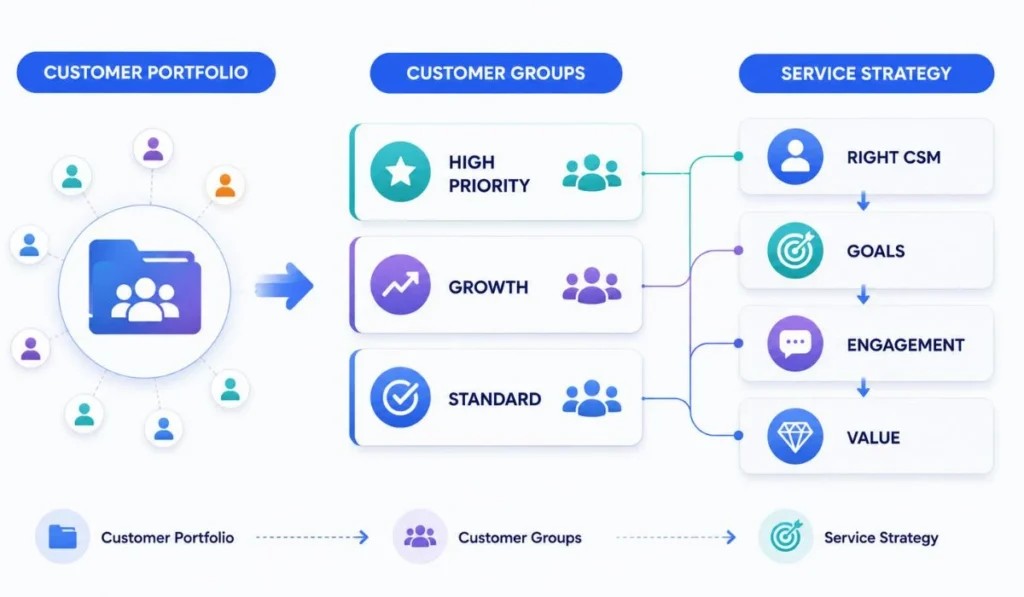
Once you have the right portfolio for all kinds of customers, you can create the service packages for each of them. You can do so by:
Assigning the Right Customer Success Representative
Different CSMs have different levels of expertise and experience. Assigning the ones with the right skill sets to the right kind of customers is paramount for you to conduct your customer success service.
Defining Goals
You need to define goals for the customers belonging to different stages in their customer journey. Their portfolios are different and so are their goals. What they want to achieve as the next milestone should be thoroughly understood by your CSMs and must be worked with.
Customer Engagement
Based on customer service knowledge, your customer engagement strategy must take shape. You must allocate right amount of time and effort for the customers needing most to least support from you. Which customers need most and least support can be known by looking at different parameters in their portfolio.
Showing Value
Demonstrating value from time to time is an important part of customer success practice. Hence, what values to be shown to which customer can be known through the customer portfolio.
Common Challenges in Customer Portfolio Management
While effective Customer Portfolio Management can massively help your business grow, there are a few challenges you might face in its implementation or operation.
- Incomplete customer data: Incomplete customer data can prevent you from recognising the customer needs and creating the best strategy for retention and/or expansion. It can also lead to erroneous strategies that may have the opposite effect
- Data silos: Data silos are collections of data by separate departments of a business that is inaccessible to other departments. They are generally notorious for preventing effective collaboration. In this case, it can prevent proper Customer Portfolio Management as relevant data will be stored away in different silos
- Poor customer segmentation: Customer segmentation can enhance how a business interacts with its client base but poor customer segregation will affect this interaction. It might lead to misguided priority levels, inaccurate risk assessment and budget misallocation.
- Outdated customer information: Proper review and update of Customer Portfolios is a necessity. Outdated information can affect your retention/expansion strategies
- Limited visibility into customer health: Customer Health Score helps you predict future customer engagement including risks of churn and expansion possibilities. Limited visibility of customer health will make you miss risk signs, upselling windows and misjudge priority.
- Scaling customer portfolio management: Scaling Customer Portfolio Management can be challenging. High volume can interfere with creating and maintaining deep bonds with high value customers.
Wrap Up
Customer portfolio gives you an immense amount of knowledge about your customer base. To serve them well, it is crucial for you to know them, their business, their contact persons, and much more. Only through right understanding of a customer would you be able to add value to their business and build a lasting relationship.
Frequently Asked Questions
Customer Portfolio Management is an approach where a company’s (B2B) customers are segmented into distinct groups based on factors like value and behaviour instead of being treated as a single market.
A customer portfolio should contain details like
Company’s name
Point of contact and associates
Industry and domain
Products or services being used
Ticket size, average revenue and billing information
Type of relationship
Potential upsells or cross-sells opportunities
Effective customer portfolio management can aid customer segmentation based on value, size or needs. This helps the Customer Success (CX) spot accounts at risk of churn, effectively upsell and grow revenue.
CRM or Customer Relationship Management is a daily customer relationship tracking tool. It focuses on individual clients. By contrast, Customer Portfolio Management focuses on customers in groups to effectively retain and expand. Its goal is long-term profitability.
Many financial advisors recommend reviewing customer portfolios once every quarter.
Customer Health Score is a predictive metric that predicts the likelihood of a customer’s future behaviour. It predicts whether a customer will retain, upscale or churn (drop their subscription).
Customer Segmentation refers to the grouping of customers based on value, size or needs. This can help portfolio management by aligning asset allocation, avoid heavy resource spending on low-value customers, customize offerings according to value, and tailor strategies.