

SaaS companies depend heavily on recurring revenues. As such, the main goals of any Customer Success strategy in a SaaS company are to renew subscriptions and expand customer accounts. As a proficient technology provider, you should realize the importance of different stages in the customer journey. And if you want to make the most of the customer journey, then the LAER model is something you must be aware of.
There has to be a proper understanding of different stages of the customer journey. When you break down the customer journey into these stages, it becomes easier to focus individually on those stages to finally achieve your business goal, i.e. revenue generation.
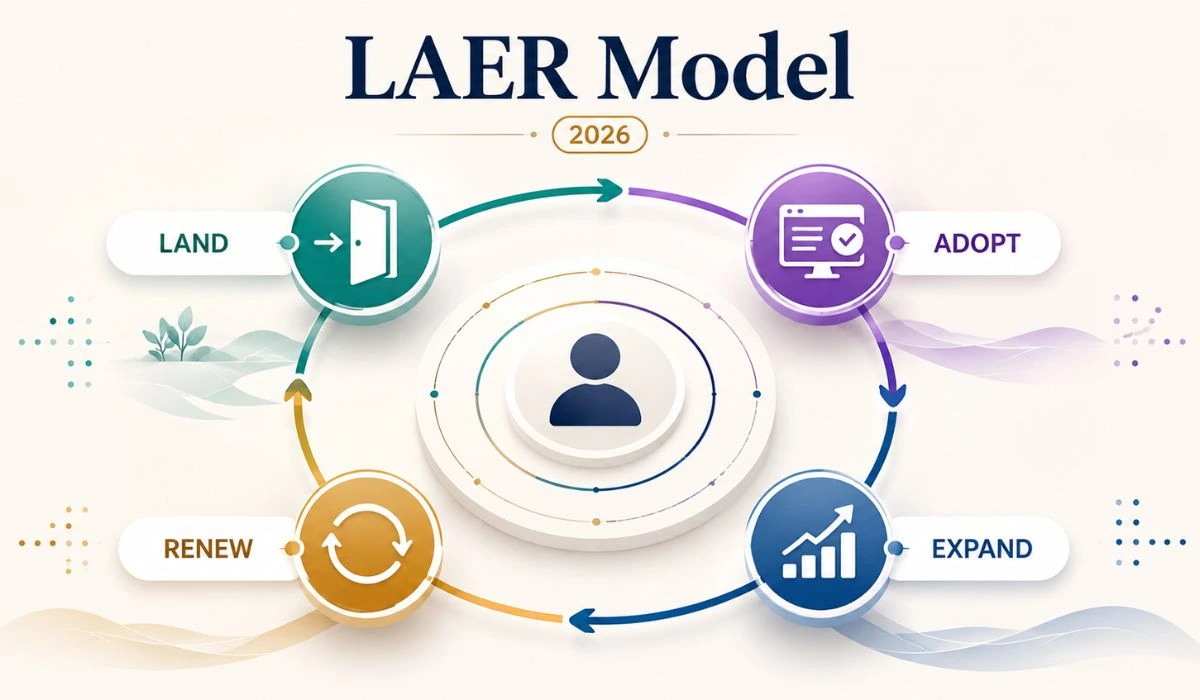
The LAER customer engagement model can help you do exactly that. LAER stands for Land, Adopt, Expand and Renew. It aligns the teams in an organisation around acquisition, adoption, growth and retention.
LAER is particularly relevant to SaaS and recurring-revenue businesses, where customer acquisition is followed by ongoing adoption, expansion and renewal. This blog focuses on stages, team responsibilities, KPIs, and implementation of the LAER model.
What Is the LAER Model?
This is one of the customer engagement models introduced by Technology Services Industry Association (TSIA) that helps companies drive business growth. It basically encompasses the four stages of a customer journey as mentioned below:
Land
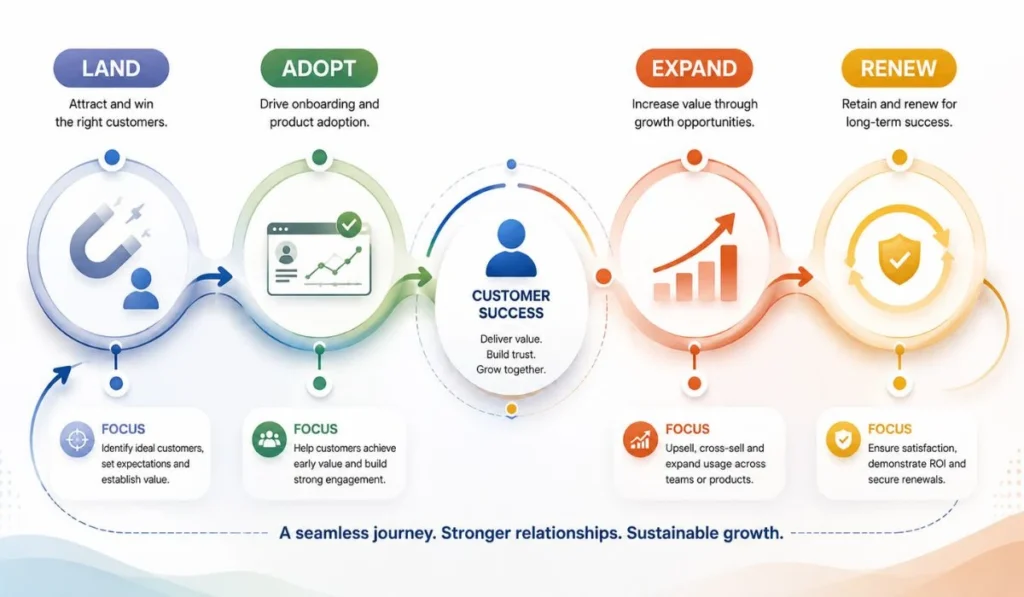
The first step of the LAER model is obviously concerned with acquisition. But it is more than just closing the deal. It starts with defining the types of companies that could potentially be your customers and ends with your first commercial commitment with a customer.
A few things to keep an eye on for the Land stage:
- Ideal customer profile: ICP is a profile you create that defines the ideal customer of your service. Aligning the ICP with the Land phase can yield more long-term users.
- Initial value hypothesis: The Land stage is where you devised your initial value hypothesis. It is an assumption about the overall benefits your product will supposedly provide your customer, and what value it will create.
- Expectation setting: Expectation setting involves bridging the gap between pre-sale promises and post-sale reality. You need to set the expectations realistically after analysing all the factors that may affect the value realization of that customer.
- Handoff readiness: Land stage of the LAER model is preoccupied with acquisition-related strategy. When it moves to the Adopt stage, teams owning the Land stage (sales and marketing) should be ready to hand off business outcome goals, technical expectations, and customer context to the customer success who owns the Adopt stage.
- First commercial commitment: The first commercial commitment marks the end of the Land phase. It is a binding contract or a product order that moves the business from pre-sales to active commercial sale.
Adopt
Adopt is the second stage in the LAER customer engagement model. It moves the customer from purchase to usage. It is the completion of the onboarding process.
This is the stage where the customer must hit value realization. In order to do that, the customer success team must spend their efforts towards user activation and removing barriers to effective adoption.
A few things to keep an eye on for the Adopt stage:
- Feature adoption: Track whether the customer successfully adopts the features in their workflow. Poor feature adoption can lead to negative value realization.
- Active and sustained usage: Track whether the product usage becomes habitual. One-time usage will not translate into a long-term business relationship.
- Time to first value: Time to first value refers to the time it takes a customer to gain an agreeable level of value from the product from initial sign-up. It should be as short as possible for efficient adoption.
TSIA’s current adoption guidance emphasises onboarding, engagement and adoption as distinct stages leading toward meaningful outcomes
Expand
After the customer successfully adopts the product and achieves value realization, expansion opportunities can present themselves. This stage focuses on expanding existing customer accounts through additional products, increased usage, new departments, upselling and cross-selling.
A few things to keep an eye on for the Expand stage
- Upselling and Cross selling: Upselling refers to pitching upgrades or additional features to existing customers. Cross selling refers to pitching a different relevant product. Finding the appropriate time for either is key.
- Increase in usage: An existing customer’s increase in usage marks a natural value realization. It is usually a favorable condition to upsell or cross sell.
- New departments: A satisfied customer might consider using your product in a different department within their own organization. It is a potential expansion.
- Higher service tier: Move a potential upselling/cross-selling customer to a higher service tier. It aids expansion and also facilitates the Renew phase.
Renew
Renew is the final stage in the LAER model of customer engagement. This is where you secure subscription renewals and avoid last minute churn. The common mistake you might make in the Renew phase is treating it as a last minute sales event. Customer retention and renewal is the outcome of value delivered throughout the lifecycle.
A few things to keep an eye on for the Renew stage:
- Renewal readiness: It refers to an evaluation of the customer’s readiness to renew the subscription to your product. It is based on indicators such as customer health score, product usage, value realization, etc. It is performed 90 – 120 days before a subscription ends.
- Risk management: Effective renewal strategy requires proactive risk management. Risks to renewal usually start before the renewal stage, but last minute issues do arise. You must be prepared to handle both.
- Outcome validation: it refers to the process of proving the outcome that your product yielded for your customer with tangible results like ROI (Return on Investment). It is more effective compared to tracking only feature adoption.
- Stakeholder alignment: internal teams and customer decision-makers have to agree on business goals, values, and solutions. Discord will create barriers to renewal.
- Advocacy where appropriate: Satisfied customers can become your biggest advocates. In the renewal phase, encourage companies (who already renewed) to recommend your product to others.
Why the LAER Model Matters for Recurring-Revenue Businesses
The LAER model is particularly relevant to SaaS, subscription and XaaS businesses because recurring revenue depends on ongoing customer value.
A one-time customer acquisition is not enough in this case. Product adoption by the customer should influence retention and expansion. They define revenue growth for such organisations.
The LAER model facilitates the connection between sales, customer success, product, services, and support teams. This cross-functional alignment stops data silos and coordinates the efforts of all the departments involved for all four stages of the customer lifecycle. Customer outcome should be what guides these efforts. It should be about value realization more than maximizing sales.
TSIA (Technology & Services Industry Association) frames LAER as a way to support XaaS (Anything as a Service) transitions, retention, and long-term recurring-revenue growth.
How to Implement the LAER Model
As we saw in the definition above, there are multiple teams involved in executing this model. Each of these teams have a particular goal in mind that ultimately serves the overall business need. So, let’s see how these teams can execute these stages in the customer journey.
Land
| Area | Details |
|---|---|
| Responsible Teams | Sales and Marketing |
| Business Goal | Acquisition and setting expectations |
| Core Activities | Define value and user profile, and set expectations |
| Key Data | Initial value hypothesis |
| Success Metrics | Acquisition metrics, quality metrics and transition metrics |
| Handoff Requirements | Customer intent, expectations, value hypothesis |
- Identify customer needs, pain points and challenges. You must be clear right from the beginning what problem you are trying to solve through your product or solution.
- Create user personas and important use cases with respect to your solution.
- Check the feasibility report of your solution and draw clear inferences on how your product would help solve the customer problem.
- Define the value that you are going to achieve for your customers.
- Initiate the sales process keeping customer success in mind and using the above preparation.
Adopt
| Area | Details |
|---|---|
| Responsible Teams | Customer Success, Onboarding |
| Business Goal | Turning new purchase into a long-term user |
| Core Activities | Onboarding, value realization, training and education |
| Key Data | Usage time, event logs, support ticket information and feedback |
| Success Metrics | Time to Value (TTV), feature adoption rate, Customer Health Score |
| Handoff Requirements | Proper team ownership, success metrics, business goals and value thesis |
Once the sales process completes, you need to help customers start achieving value from the product. Onboarding and time to first value are the most important factors in the Adopt stage.
- Identify the key stakeholders who would be involved in the customer relationship. They include customers, customer success managers, end-users, customer’s technical lead, etc.
- Create the value propositions for each of the customer’s personnel and present that to them.
- Monitor the product usage through a customer success platform and identify the features that are being used and not used by the customer.
- Drive effective customer engagement to enhance their product experience and encourage them to use more features in the product.
- Identify customer challenges in the product usage that are preventing product adoption and fix them immediately.
- Keep educating the customer about the new product features and train them for a better usage of the product.
- Continue above steps until the user active time on the product increases and features usage passes the threshold.
Expand
| Area | Details |
|---|---|
| Responsible Teams | CS, Account Management, Sales |
| Business Goal | Increase revenue from existing customers |
| Core Activities | Upselling, cross-selling, acquiring use cases across different departments |
| Key Data | Advanced feature adoption rates, support ticket volume, customer satisfaction data, renewal date |
| Success Metrics | NRR (Net Revenue Retention), Expansion Revenue, Customer Lifetime Value (CLV) |
| Handoff Requirements | Account context, usage data and new stakeholder maps |
After the customer successfully adopts the product and hits value realization, expansion opportunities present themselves. This stage is concerned with expanding existing customer accounts through additional products, increased usage, new departments, upselling and cross-selling. Below are the steps needed for account expansion:
- Hold quarterly business review meetings to identify the evolving needs of the customer.
- Show them the product performance that has helped them achieve their business goals so far.
- Identify the solutions that you can provide and are most needed by the customer.
- Align your sales team to create collaterals for the sales pitch for upsells or cross-sells.
- Share with the sales team what value means for the customer and how they were able to adopt the primary product.
- Set up a meeting with the key stakeholders for upsell and cross sell pitches, explaining how they could benefit performance and growth
- Monitor the sales process through a sales automation platform.
Renew
| Area | Details |
|---|---|
| Responsible Teams | CS, Renewals, Account Management |
| Business Goal | Subscription renewal, protect recurring revenue and prevent churn |
| Core Activities | Customer Health Score tracking and renewal discussions |
| Key Data | Usage frequency, support ticket volume and billing dates |
| Success Metrics | Gross Renewal Rate (GRR), Net Revenue Retention (NRR), Customer Lifetime Value (CLV) |
| Handoff Requirements | Return on Investment (ROI), usage metrics, risk and blockers log |
No matter how many products or solutions you sell to your customers, until they renew their subscription for the next period, your customer success efforts are incomplete. Renewal is not just something you hope for. You have to pursue the customer through various steps towards this end.
- Monitor the right KPIs throughout the customer journey.
- Identify the early signs of customer churn. This may include reduced active time on product, number of logins, kind of customer queries, etc.
- Fix these issues immediately to keep the customer health score green.
- Prioritize the customers for the service whose renewal dates are close.
- Encourage customers for brand advocacy.
LAER Roles and Responsibilities
| Stage | Primary Teams | Supporting Teams | Main Outcome |
| Land | Marketing, Sales | Solutions, CS | Qualified customer and clear value case |
| Adopt | Customer Success, Onboarding | Product, Support | Initial and sustained value |
| Expand | CS, Account Management, Sales | Product, Finance | Additional customer value and revenue |
| Renew | CS, Renewals, Account Management | Support, Finance | Continued relationship and recurring revenue |
The ownership of each stage differs by company and sometimes by customer segment. It is not written in stone.
KPIs for Each LAER Stage
In the LAER model, all four stages of the customer engagement lifecycle do not share the same focuses, teams or metrics. Each stage has its own sets of KPIs (Key Performance Indicators) that align with the customer needs, behaviours, and business goals particular to that stage.
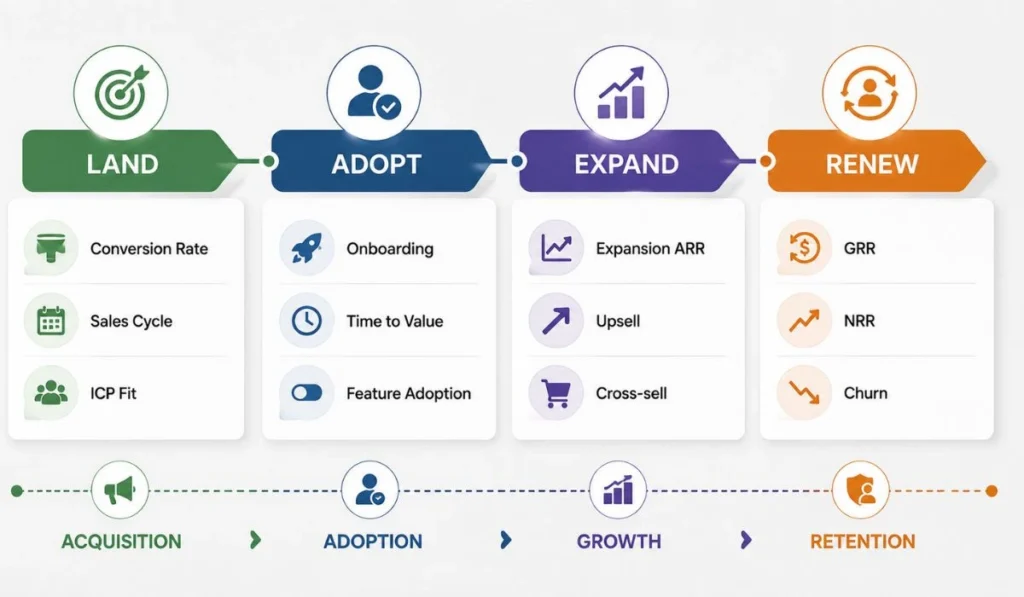
Here is a table featuring major KPIs for each stage:
| Stage | KPIs |
| Land | conversion rate, sales-cycle length, ICP fit, acquisition cost |
| Adopt | onboarding completion, time to value, activation, feature adoption, engagement |
| Expand | expansion ARR, upsell rate, cross-sell rate, product penetration |
| Renew | gross renewal rate, GRR, NRR, churn rate, renewal forecast accuracy |
Note: These metrics are not universal benchmarks. Companies might use other metrics that align more with their organisation.
LAER vs Other Customer Lifecycle Models
LAER is not the only customer engagement model. Other popular customer lifecycle models include:
- traditional sales funnel – a linear pre-conversion model that moves from awareness to purchase
- Bow Tie model: A bowtie/hourglass model where the left side is pre-sale acquisition and the right side is post-sale value delivery.
- APLAER: APLAER is a model that involves two additional stages (Analyse and Place) than LAER.
- DARE: DARE is a model built specifically for AI-driven services. The acronym stands for: Design, Activate, Realize, and Evolve.
| Model | Main Focus | Best Used For |
| LAER | Acquisition through renewal | Recurring-revenue lifecycle management |
| Sales funnel | Pre-sale conversion | Marketing and sales |
| Bow Tie | Acquisition and post-sale growth | Revenue lifecycle alignment |
| APLAER | Data-led pre-sale and post-sale engagement | Complex XaaS environments |
| DARE | Continuous outcome realization | AI-driven and evolving services |
Common LAER Implementation Mistakes
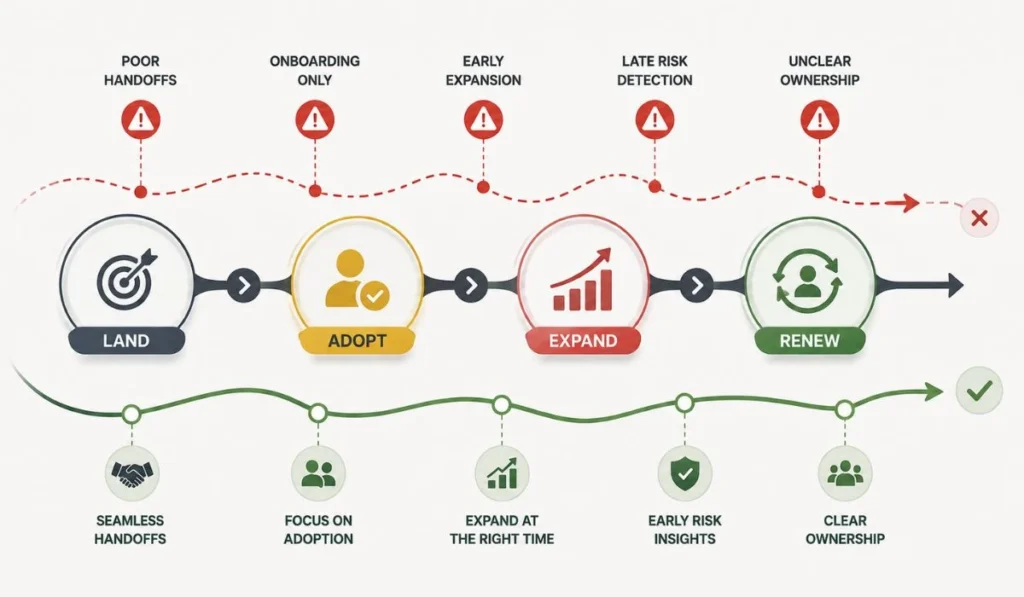
- Treating adoption as onboarding only: Adoption doesn’t end the moment a customer starts using the product. It should be treated as an ongoing process
- Pursuing expansion before value is proven: Trying to push expansion before value realization will overwhelm your customer and lead to early churn.
- Waiting until renewal dates to address churn risk: Customers often make up their minds long before the renewal dates. Waiting until renewal will cost you a customer
- Unclear ownership between Sales and Customer Success: If the handoffs between Sales and Customer Success are not carried out properly, it will lead to confusion and ambiguity, which will heavily affect the implementation.
- Measuring activity instead of outcomes: Activity metrics are not proof of value. The teams could be carrying out many activities for the successful implementation, but tracking those instead of concrete outcomes will lead to a false sense of progress. What you did is important but not as much as what it achieved.
- Poor customer segmentation: Customer segmentation helps coordinate retention and expansion strategies. Poor customer segmentation leads to wrong pitches for the wrong customers.
- Compensation plans focused only on acquisition: The incentive compensation for the sales team has to be spread out throughout all four stages. Incentivizing only acquisition will lead to neglect of onboarding and expansion.
- Insufficient product-usage data: Product usage data allows teams to plan their strategies accordingly. Insufficient data can leave teams blind to churn risks and expansion possibilities. This can be especially counterproductive in the Adopt stage.
Wrapping Up
All these stages in the LAER model require proper orchestration by the customer success director. Different customers are at the different stages of their customer journey. Hence, you would have to switch between different steps needed for them. The journey from LAER model beginner to LAER efficient takes time, experience and continuous learning.
By keeping a keen eye on your installed customer base, you can leverage this model to drive business growth. And once you get a hang of it, your customer success efforts would start reaping further benefits.
Frequently Asked Questions
LAER stands for Land, Adopt, Expand, and Renew
Adoption is the phase where a customer starts using your product and getting the initial value. Expansion is when they upgrade or buy other plans. It also includes getting new customers
The ownership of each stage differs by organisation and sometimes by customer segment. The common division is thus: Land – Marketing & Sales, Adopt – Customer Success & Onboarding, Expand – CS, Account Management & Sales, Renew – CS, Renewals & Account Management.
There are no universally applicable sets of KPIs to track in a LAER model but a common distribution is given below
Land: conversion rate, sales-cycle length, ICP fit, acquisition cost
Adopt: onboarding completion, time to value, activation, feature adoption, engagement
Expand: expansion ARR, upsell rate, cross-sell rate, product penetration
Renew: gross renewal rate, GRR, NRR, churn rate, renewal forecast accuracy
An organization is said to be LAER efficient when it has managed to optimize the customer lifecycle model to yield maximum growth and renewal with minimal cost.
The LAER model was a customer engagement model with high efficiency during the traditional SaaS era. With rapid adoption of agentic AI in SaaS, the linear model of LAER is being largely replaced with cyclical models like DARE, which are specifically catered to AI-driven services.
They are both customer engagement models. In addition to the four stages of LAER: Land, Adopt, Expand and Renew, the APLAER model has two more phases. Analyse and Place.
They are both customer engagement models but with different purposes. LAER is focused on acquisition through renewal, while DARE is focused on continuous outcome realization.