

Businesses love to use customer testimonials on their website. The reason is that it builds trust amongst potential customers and builds goodwill in the market. However, not every business follows ethics and posts authentic customer testimonials on their websites.
Certain companies shamelessly try to replicate the customer feedback from other websites in their industry, which is never a good practice. Such companies suffer a lot in terms of legal hassles in the long run. To avoid legal hassles while using customer testimonials on your website, you need to follow certain legal guidelines.
Having a salesy version of customer testimonials will pay in the short term, but in the long term, only authentic and genuine customer testimonials will help grow your business to the next level. Sincere and high-quality customer testimonials can help overcome the scepticism of your product in the mind of potential customers. They help prospective customers get on board who are unsure about the legitimacy of your product.
Replicating other companies’ feedback, using inauthentic promotional testimonials, including inaccurate claims, and improper disclosures are practices that should be avoided when publishing customer endorsements. Customer testimonials are a great way to strengthen trust and bring in new clients, but businesses must ensure that they are authentic and legally compliant.
In this write-up, we have provided a brief overview of these legal guidelines that will help you to post authentic customer testimonials on your website. By legally doing everything, you ensure that the effectiveness of your customer testimonial increases by manifolds.
Whenever you post a customer testimonial on your website, ensure that it is truthful and not misleading in any way. On top of this, some specific rules need to be followed while using these customer testimonials on your website. Here are some of them.
Why Customer Testimonials Matter for Businesses
Customer testimonials are a common method of social proof. They embolden potential customers to put their trust in your company/product/service. As building trust is an integral part of any business, customer testimonials can help your business bridge the gap between curiosity and interest.
Human beings learn everything from speech to astrophysics by mimeticism (practice of imitation). B2B sales are no different. Customers tend to look at other buyers in the same industry to help their purchase decision. This is where the importance of social proof becomes apparent. By adding authentic customer testimonials to your content, you can massively influence your brand credibility among potential buyers.
Customer testimonials can influence trust and acquisition, but they should not be used only as promotional content.
Legal Guidelines for Publishing Customer Testimonials
Testimonials are considered marketing tools and can increase conversion rates by building trust through social proof. But the responsibility for ensuring the authenticity of claims that appear in customer testimonials lies with the business publishing them. Even if you publish authentic testimonials exclusively, obtain customer permission and follow proper disclosure practices to reduce compliance risks.
FTC Guidelines for Customer Testimonials and Endorsements

Testimonials must reflect genuine customer experiences
Many companies follow improper methods like offering financial incentives for praise, cherry-picking rare positive testimonials, suppressing negative reviews, rewriting feedback, etc. These may help in the short term, but they are the wrong tactics if you want to build honest relationships with your customers. Do not attempt to influence customer testimonials in any way.
Businesses should avoid misleading claims
Make only claims that you can deliver on. Tricking customers into buying your product using misleading claims is against FTC guidelines. They are especially stringent about businesses that make fake claims about health and fitness.
Results and performance claims should have supporting evidence
All claims that point to results and performance to assert authenticity must disclose their supporting evidence. The evidence thus disclosed has to be objective and reliable. Furthermore, the evidence should be kept ready before the claim is published. Testing after the claims have been made and published is not accepted. FTC also provides clear guidelines regarding claims made through testimonials and endorsements. A company cannot use testimonials and endorsements as a loophole to avoid substantiating their claims
Material relationships or incentives must be disclosed
If someone is endorsing a product, they have to reveal any material relationship they have or had with the company. If they received an incentive for the recommendation, they are required by law to disclose it within the content of the endorsement.
Disclaimers should be clear and easy to understand
FTC considers many factors when it comes to disclaimers/disclosures.
- Placement: It should not be placed somewhere that is likely to be overlooked.
- Readability: The font should be legible, and the background color should contrast the font color to make it stand out.
- Clarity: The wording of the disclaimer should be devoid of ambiguity. A disclaimer/disclosure cannot hide between complex, intentionally ambiguous articulation
FTC regulations are subject to change. Businesses should consult the official guidelines before publishing customer testimonials to ensure compliance.
Testimonials Need to Be Original
As we discussed in the introduction, replicating a customer testimonial from a competitor’s website can have considerable legal repercussions. You also can’t simply copy and paste a review you found on a third-party website in your industry as a customer testimonial on your website. More often than not, the user retains ownership of user-generated content and licenses it to the website. So, if you copy and paste the testimonial of some other site on your website, you end up infringing the intellectual rights of the person who wrote the testimonial. It is not the ethical way to publish customer testimonials.
In these cases, your options may seem limited, but they can save you from unnecessary legal hassle and safeguard you from GDPR laws. You can:
- Use links that direct to these review sites
- Obtain permission to republish reviews from third-party platforms
Under no circumstances should you copy testimonials from competitors’ websites or third-party platforms. Not only is it unethical, but it can also decrease your customers’ trust in your business.
Ask Written Permission Before Posting Testimonials
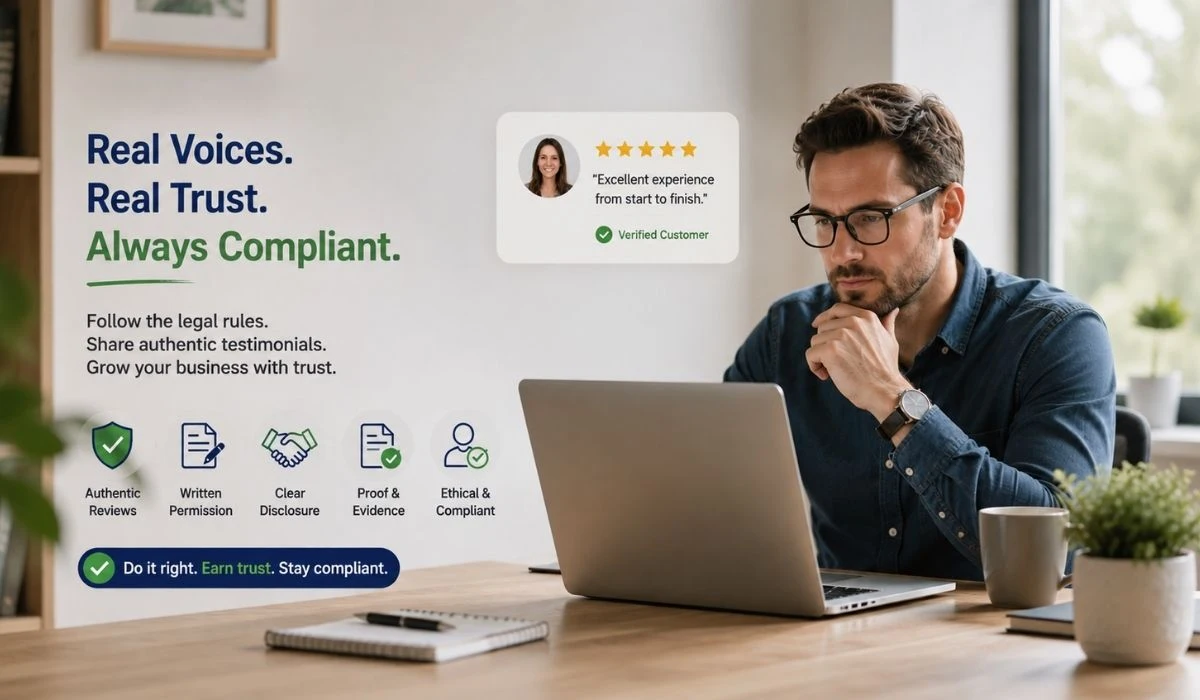
The best practice when it comes to using customer testimonials on your website is to obtain formal written permission from the customer before publishing. Usage rights of any content that the customer posts will remain with the customer. You can obtain a license from them to use it on your website.
These permissions are usually drafted with a specific duration agreed upon by both parties. You may use the content for as long as the permit holds. Once the contract ends, you will need to remove the customer testimonial.
The drafting of the contract is very important for both the customer and the company. Any concerns with where the testimonial can appear (website, social media, advertisements) or whether the customer can request updates or ask for it to be withdrawn should be addressed within dedicated clauses of the agreement.
The Customer Testimonial or Endorsement Should Be Truthful and Accurate
Federal Trade Commission’s Revised Endorsement Guidelines says the most crucial aspect of the customer testimonial is that it needs to be truthful. The endorser’s honest opinions, findings, beliefs, or experiences play a crucial role here. In other words, you cannot post customer testimonials of people who did not purchase anything from you.
For example, you see an advertisement for SmartKarrot, a customer success platform that shows how you can increase your new customers without reducing the number of existing ones. In the ad, the company shows that by using SmartKarrot they were able to achieve the end objective. If any other software is used to increase the number of new customers without reducing the existing ones, the prospective customers will not yield the same result.
The guidelines also highlight the need to depict the actual experiences. If it is not based on actual experiences, it needs to be put across in an easy-to-spot disclaimer. If you make any false statements, you can be held legally liable for trial.
Claims made by the customer are to be measured and verified by the business before publishing them. A customer might not necessarily be aware of the difference between an objective measurable claim and a subjective opinion. The business needs to differentiate them and verify the objective claims before publishing them.
Always Back the Testimonial With Proof
As we already discussed, subjective and objective claims are entirely different, and a company needs to be aware of the difference when a customer makes either in a testimonial.
Subjective claim: <product name> was the easiest-to-use software we have used in our company
Objective claim: <product name> was able to increase our company’s revenue by 25%
The first one is an entirely subjective claim that hinges on a factor that is neither measurable nor universal. The second one, on the other hand, is a claim that can be verified with enough data and metrics.
Adding the necessary proof to validate claims in a customer testimonial is not just a legal safeguarding measure. It can also improve customer trust and credibility. You can include detailed case studies, data-backed outcomes, customer verification, and supporting documentation as proof of authenticity of the claim.
Properly Disclose the Connection Between You and the Endorser
You must disclose your connection with the endorser under FTC guidelines. This applies to paid partnerships, incentives, employees, affiliates, and any other relationships that may affect a customer testimonial.
The best way to move forward with disclosure is by creating a policy in your organization wherein, if the testimonial is received within your business; they should be segregated between employees, shareholders, and investors.
Another example is that Amazon has issued a mandate for all its associates, like business bloggers and bloggers who earn referral fees by placing links to their products on sale on Amazon.com on their websites, to disclose that they are Amazon affiliates. And they will get paid when users purchase a product from their promotion.
If you do not disclose this vital piece of information, it can be detrimental to your business. You can end up in legal hassles. Hence, it is always crucial to have all disclaimers and disclosures put across in simple language so that any layperson can understand you without any trouble. A prime example is using a short statement like – this review was funded by <<INSERT THE NAME OF THE COMPANY HERE>>. Disclosures through vague means like social media hashtags are generally ill-advised.
Customer Testimonial Checklist Before Publishing
- Confirm the testimonial is from a real customer: When a business publishes a customer testimonial, the liability to ensure its authenticity rests completely on the business
- Obtain written permission: You should obtain written permission from the customer before you publish their testimonial. It can avoid legal risks and also act as proof of authenticity.
- Verify claims and measurable results: Customer testimonials are not free from the burden of proof. If an objective, measurable claim is made, it must be backed by evidence/results. Verify such claims.
- Disclose incentives or relationships: If your business has awarded any financial incentives or if it has any prior relationship with the customer, it must be clearly stated.
- Remove outdated testimonials when necessary: Outdated customer testimonials can affect your credibility. For instance, a customer testimonial from 4 years ago can have reduced relevance because it will not address any major changes your business, product, or service may have undergone in the last 4 years
- Ensure customer information is handled appropriately: You might collect a considerable amount of data from your customers to ensure credibility. Keeping such information and data secure is your responsibility.
Final Thoughts
Always keep in mind that any false claims you make in the customer testimonial can make you pay ten times in a legal coup. Adhere to the guidelines issued by FTC and ensure that all the customer testimonials on your website are 100% authentic and original that back your product usability.
In addition to this, ensure that the endorsers disclose their affiliation with your company. This can authenticate the customer testimonial and go a long way in securing the trust in the minds of website visitors.
Once you follow the FTC protocols mentioned in this blog, you can save yourself from any legal coup or penalties from any governing bodies that check the authenticity of customer testimonials on your website.
From the bottom of my heart, I pray that you always stay safe from the legal hassles of any discrepancies in your customer testimonials.
Frequently Asked Questions
Yes. According to the Federal Trade Commission guidelines, customer testimonials are a form of marketing, i.e, advertising, when a business uses them to promote itself
Yes. Regardless of where they source it from, businesses need formal written permission from customers to publish any content made by the customers. Text, photos, or videos created by the customer are protected by copyright laws.
Companies can offer incentives to solicit reviews, but they cannot demand that the customer who receives the incentive leave only positive reviews. Furthermore, the financial relationship (incentive) should be disclosed in the testimonial regardless of whether the review was positive or negative.
Businesses can ensure the authenticity of customer testimonials by reducing incentivized reviews, asking relevant questions during feedback, and verifying collected data/information.
Here are some of the best practices to create effective customer testimonials to increase customer conversion rate:
1. Approach your existing customers to provide their testimonials
2. Always choose the best customers
3. Cover all the clients from different buyer personas
4. Ensure that you give a brief outline of the testimonial to the existing customers to reduce their workload
5. Make sure that the testimonials that you use on your website are solutions-driven
6. Provide quantifiable, tangible results in the customer testimonials
7. The facts that you present in the customer testimonial should be verifiable
8. Select the video format to post the customer testimonials
An effective customer testimonial can prove to be decisive in giving a necessary push to the conversion rate and make new net customers. But not every customer testimonial is effective. Here are the desirable qualities that a good customer testimonial should have:
1. The testimonial needs to be precise and provide a solution to the prospective customer
2. It should outline the customer’s problem and explain how they used the product to resolve their problems.
3. Include verifiable sources for the prospective customers to trace the source of the customer testimonials
4. Ask a prominent decision-maker like a senior CSM or a CCO to present the testimonial on your website
5. Have a diverse customer base on your testimonial page on the website
In the B2B SaaS world, one way to get an edge over your competitors is by showcasing how your customers resolved their problems using your product. Prospective customers find the testimonial page quite useful while researching for the right product before purchasing it.