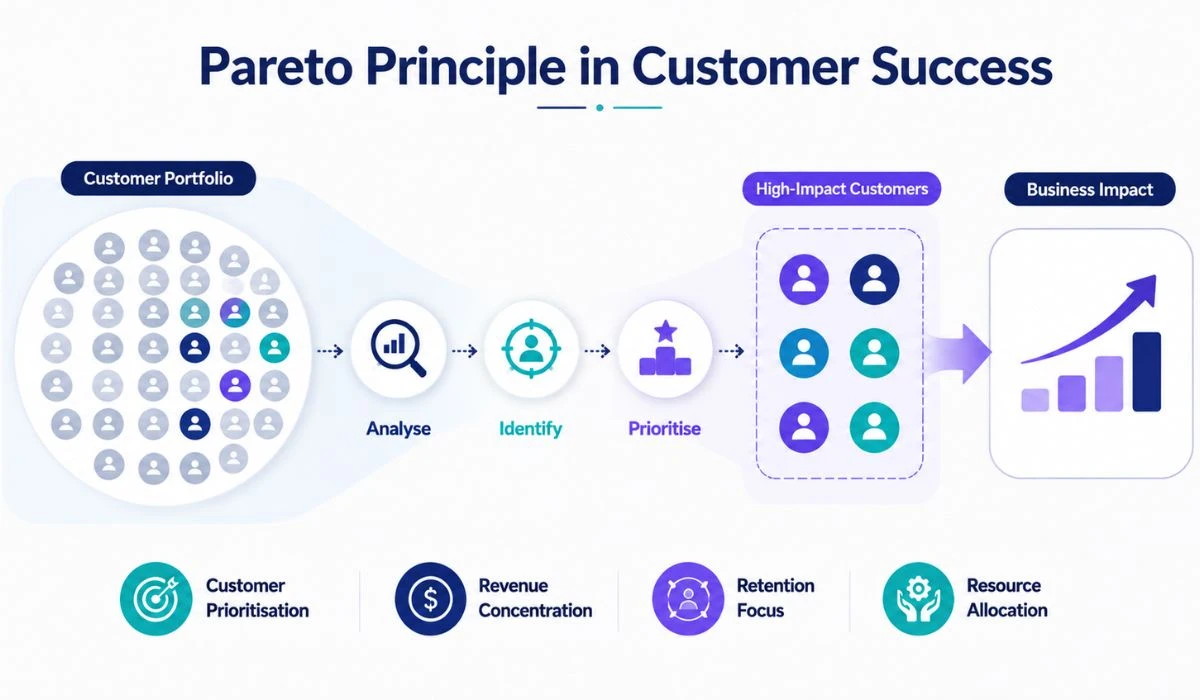


Chances that you may have heard about the 80:20 rule or the Pareto Principle are high. The Pareto principle is also called the law of the vital few. The idea is: 80% of the effect is produced from 20% of the cause of the event.
In 1906, Vilfredo Pareto from Italy made an observation that nearly 80 percent of Italy’s land was owned and controlled by nearly 20 percent of the population. This finding led him to explore other countries where he noticed similar situations.
The principle has then been applied to various spheres like software, business, marketing, and more. In marketing, the Pareto principle says that 80 percent of your sales are represented by 20 percent of your customers. If companies break free from this, they will increase profits. Note that the split is not exactly 80:20; it is more of an approximation.
The 80:20 rule of the Pareto Principle can be observed in various areas of business like revenue generation, product adoption, customer support, and renewal. When understood correctly and taken into account, the Pareto Principle can increase the efficiency of Customer Success.
Is the 80/20 Rule Always Exact?
The 80/20 rule is an observation that can benefit customer success, but it is not a universal law. It may not always be accurate to the dot either. The actual ratio can vary. Moreover, the inputs and outputs in this rule are different units.
The Pareto Principle may be an effective tool for business, but it should not be taken entirely at face value. Completely ignoring the other 80% may greatly affect your business. Always let real data determine the actual concentration.
Customer Success Pareto Principle
Pareto Principle in Customer Success says that repeat customers generate revenue that is nearly 16 times more efficient than one-time customers. The potency of the 80/20 rule in Customer Success is that 20 percent of a group is responsible for 80 percent of the sales. So, if you can retain customers or make them more than one-timers, the chances of revenue earned are higher.
For example, let’s take a look at the revenue efficiency of the 20% “vital few” and the remaining 80% majority.
To find the revenue of any customer segment,
Revenue Efficiency = % of Total Revenue ÷ % of Total Customers
If 80% of your total revenue is created by 20% of your customers, their revenue efficiency would amount to 80 ÷ 20 = 4
If 20% of your total revenue is generated by 80% of your customers, then their revenue efficiency would be 20 ÷ 80 =0.25
Pareto Principle is not exclusively applicable to revenue generation. An efficient Customer Success team might find patterns of it across other areas of business like:
Expansion Revenue: a minority of accounts generate the majority of expansion revenue
Churn Risk: A minority of customers carry the majority of the total churn risk, which can be identified through tools such as a customer health score.
Product adoption: a minority of your features drive the majority of product usage
Customer Support: a minority of feature issues cause the majority of support tickets
A tactful Customer Success strategy should use the Pareto Principle to identify high-value customers and ensure that they are given the appropriate attention. But you should not ignore the remaining customer base.
Every customer contributes to the market share. The size of the organisation is what affects the market and helps find scope for investment. It is important to keep the Pareto principle in mind while not faltering on keeping customers retained.
How to Conduct a Pareto Analysis in Customer Success
- Define the outcome to analyse: Clearly define the core problem or the effect you want to study
- Select a consistent time period. Customer behaviour, revenue generation, and complaints change constantly. Decide on a specific time period for more accuracy.
- Gather customer or operational data. Without relevant data, a Pareto analysis might produce unreliable results. Acting on it would be detrimental to the organisation. Pull the data from CRM.
- Group results by customer, issue, feature or segment. They are your potential “20%.”
- Sort values from highest to lowest. Sort the categories from highest to lowest value/frequency.
- Calculate each item’s share of the total. Share of total = individual value ÷ total value × 100
- Calculate cumulative percentages. Add them one by one to identify the impact share of each category
- Identify the small group responsible for most impact: The minority category that has the most impact will be your focus point
- Investigate causes: Analyse relevant data to find any hidden causes for the imbalanced impact.
- Define and monitor actions. Divert interferences and resources towards the impactful category and monitor if your intervention causes any changes
Customer Service and Pareto Principle
In Customer Service, you might observe the Pareto Principle in how:
- a small number of issue categories create most support volume
- a few product defects generate most escalations
- a subset of customers uses most support capacity
If a team spots these patterns, they can take specific tailored measures to counteract them.
| Problem | Possible fixes |
| Small number of issue categories create most support volume | Product fixes, targeted self-service content |
| Few product defects generate most escalations | Group support tickets by cause, deploy hot fixes |
| A subset of customers uses most support capacity | Encourage self-service (guides or video tutorials), establish fair use limits, move heavy users to a higher plan |
Customer Education
In Customer Education, the Pareto Principle reveals that focusing on 20% of the core feature usage allows your customers to realize 80% of the product value. Prioritizing your customer education efforts towards the 20% will yield faster results and might reduce Time to Value (TTV).
This is how you can identify various factors that need your attention in customer education with the help of the Pareto Principle
- High-usage features: Track product analytics to identify the 20% of features that drive 80% of the product usage to prioritise your focus.
- Common onboarding blockers: Track onboarding data to figure out the 20% of onboarding issues that cause 80% of early churn.
- Frequently searched help topics: Track the frequently searched help topics to find the 20% of issues that cause 80% of support tickets
- Support questions suitable for self-service: To create an efficient self-service tool, use the Pareto Principle to find the 20% of issues that cause 80% of customer confusion.
- Educational content: To create impactful customer education content, track the 20% of issues that lead to the majority of customer complaints.
Customer Success Example of the Pareto Principle
Let’s say a company called ABC decided to use the Customer Success Pareto Principle to upgrade its revenue generation strategy.
ABC has 100 SaaS accounts. The Customer Success team analysed their total expansion revenue and found that 18 accounts out of the 100 generate 72% of the expansion revenue. It is not an exact 80:20 split, nor does the total amount add up to 100. But it is still clearly the Pareto Principle at work. It does not need to be exact.
ABC’s Customer Success team went to work. They compared product adoption, industry, plan, and engagement of the 18% against the remaining accounts to ensure a cause-and-effect relationship. On establishing that, they grouped the 18 accounts, identified their shared traits, and created a targeted playbook to maximize customer profitability and churn prevention.
They massively shifted their attention to high-value customers who bring in the most revenue, but they did not ignore the remaining accounts. They devised dedicated, scalable programs that suit their needs and priority level.
This is how a successful usage of the Pareto Principle in Customer Success would look like.
Common Mistakes When Applying the Pareto Principle
- Treating 80/20 as an exact formula: the 80/20 rule is merely a general observation. It may not always be accurate. It can be 90/10, 70/30, etc. Moreover, the values in the 80:20 are two different units. They will not always amount to 100.
- Ignoring the remaining customers: While the 80/20 rule may help you figure out where your priority should lie (the 20%), it does not mean you should ignore the rest of them (80%). Remember that they are still a majority, and with effort, they may join the priority list as well.
- Using revenue without profit or service-cost data: one of the 20% of customers who bring in the most revenue might not always be the most profitable. You have to account for servicing costs and profit margins.
- Confusing correlation with cause: Correlation does not mean causation. Two things can happen simultaneously without one being the cause for the other. Test your 80/20 hypothesis and find out whether it has a cause-and-effect relationship or just a correlation.
- Acting on too little data: A successful application of the 80/20 rule requires a lot of data. Insufficient data will yield faulty results, misleading you to prioritise the wrong customer/customer segment
- Using outdated customer segments: Customer behaviours are not stable. Your 20% high-value customer today may not be in the same group a year later. Keep your customer segment up-to-date.
- Overlooking strategic accounts: The 80/20 rule may overlook customer accounts that hold potential for future growth, or a loyal customer that may bring in others through advocacy. It is not foolproof.
- Ignoring low-frequency, high-severity issues: When applying it in customer support, the 80/20 rule will lead to the teams prioritising issues that occur more frequently. While this may solve more customer complaints, less frequent high-severity issues that affect the product’s usefulness might end up being ignored.
- Creating unequal service without clear policy: Ultimately, applying the 80/20 rule without tact will lead to an inequality in customer service. If the remaining 80% of your customers find out about this, it will alienate them and massively affect your brand reputation.
Bottom Line
The Pareto Principle is powerful and can be applied to any business. The 80/20 rule can be applied to any business to understand profitable income, market share, geographic coverage, and overall costs. This will help understand opportunities for growth and productivity. Applying the 80:20 rule for customer success will save a lot of time, effort, and resources. However, it is not a method to explain or come to an analysis about an event. It helps us understand what should be focused on for better yield, improved growth, and impact on end goals. This will help identify what aspects of the business are not at their full potential and why. Using the Pareto Principle in Customer Success will help identify how to optimise customer success operations for overall business growth.
Frequently Asked Questions
Pareto Principle, or the 80/20 rule, is an observation that states roughly 80% of the results come from 20% of inputs. It points to an imbalance between effort and reward.
80/20 rule is merely an observation. It is neither a universal law nor always accurate.
No. In the 80/20 rule, 80 and 20 denote two different measurements. 20 is the input, and 80 is the output, which are two different units. Adding them together does not need to give 100.
In Customer Success, the Pareto Principle means that 20% of your customer base generates 80% of your revenue and 20% of user issues cause 80% of customer frustration. Identifying these can make customer success more efficient.
To calculate the 80/20 rule, collect input and output data, sort it from largest to smallest, calculate cumulative percentages, and see where the top 20% of inputs line up with the majority ( 80%) of outcomes.
Pareto analysis is a decision making and problem solving method that uses the 80/20 rule. It works by identifying and fixing the “20%” issue that causes 80% of the problems.
Pareto chart is a specific type of graph that uses the 80/20 rule. It is used to find and focus on the most important and frequent issues first.
It can help you identify the top 20% of the customers who bring in 80% of your recurring revenue. You can then prioritise them as high-value customers and employ proactive measures to avoid churn.