

To choose a product, a customer must make a conscious buying decision. This buying decision is based on subconscious emotions and triggers. Marketing and sales departments of major companies have successfully used triggers to target buyers’ emotional disposition for decades.
If you want to succeed doing the same, you must first understand what emotional triggers really do. Understanding human psychology and behavior is also necessary to create aspects that drive required action. You need to craft better messages to position the customers better.
Emotional triggers make it easy for companies to capture customers’ attention if used well, but it does not mean that the buyers’ decisions are entirely driven by subconscious processes. Rational and practical validations still need to be accounted for. Emotional triggers are better used to create initial interest and desire.
What Are Emotional Triggers in Marketing?
What goes through a customer’s mind before they decide to buy a product or a service?

Obviously, utility or functionality is the prime reason for any purchase. But the way a customer perceives and responds to a sales offer has a lot to do with what they are feeling. Emotional triggers are messages, situations, or cues that are capable of affecting a customer’s feelings enough to influence their purchase decision.
This does not mean that purchase decisions are largely made on a whim. On the contrary, purchase decisions can depend on many factors, including price, need, quality, alternatives, prior experience, social influence, and practical requirements. Emotional triggers can only influence the decision. It cannot automatically lead to purchases or to ignoring other factors.
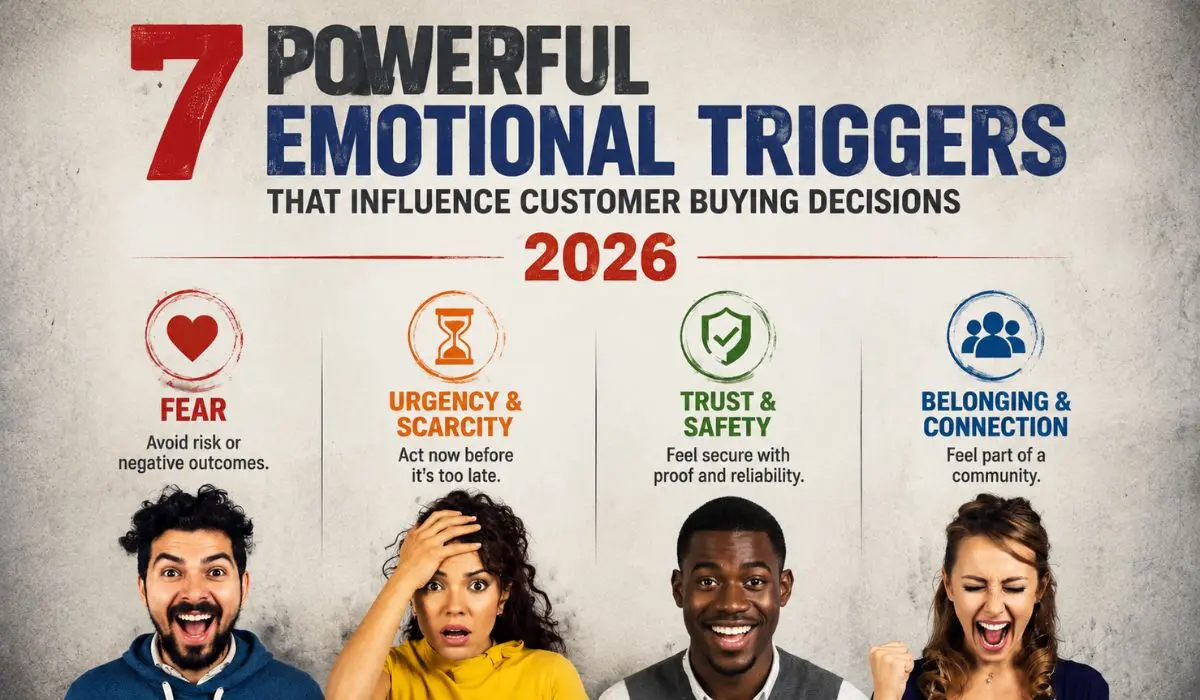
7 Powerful Emotional Triggers That Influence Customer Buying Decisions
You can use these emotional triggers to improve the buying process and customer relationships.
1. Fear, FOMO & Loss Aversion
Fear as an emotional trigger is one of the most efficient at translating into a successful marketing strategy. FOMO (Fear of Missing Out) drives many customer choices in the modern world. That is why fully stocked products experience slower sales than limited stock products.
But fear is not exclusive to scarcity. It can manifest as an anxiety of exclusion. For a SaaS customer, this effect is created when the competition gains a perceived advantage. In such situations, the feeling of “being left behind” or “trailing behind” becomes an incredible trigger for customer decisions.
Customers also experience the loss of something twice as intensely as the gain of something of equal value. This is a cognitive bias called loss aversion. You can leverage this by framing your marketing around avoiding loss. For instance, if your company has a limited-time offer, focus the marketing on what your customer will lose out on if they don’t sign up.
Example: Free trials that end at a set time. Giving up the added features feels like a huge loss
Loss aversion can also have adverse effects. If a new feature on your SaaS product offers higher value but increases your total product price, the customer may perceive the “loss” part of the deal more intensely. In such cases, frame your marketing around gains.
Note: Since scarcity is a major element in using fear as a marketing tactic, many organizations tend to rely on artificial scarcity to generate fear. This is extremely unethical and can affect trust in the business relationship.
2. Trust & Safety
Trust is a major catalyst in building customer loyalty. As an emotional trigger, it can influence customer behaviour to align with business outcomes. However, trust is not an emotional trigger that can be induced as quickly as others like fear. It has to be built slowly and planned for long-term effects. A B2B company can establish trust with its customers by focusing on a few points.
- Customer testimonials: testimonials from customers in the same field can influence trust more than promotional content
- Reviews: authentic reviews by trusted establishments can affect customer perception
- Case studies: deep, data-driven case studies drawn from customer data (like customer feedback) can provide your customers a transparent overview and establish brand trust.
- Transparent pricing: hidden pricing can disturb trust. Keep your pricing transparent
- Clear policies: Ambiguity can lead to communication errors and ultimately affect trust. Make sure your policies do not lack clarity
- Guarantees: When it is appropriate and necessary, offer guarantees to ensure customer success
- Security/privacy information: Privacy and security are integral in the modern era. Provide adequate information about measures you adopt to ensure both.
- Consistent customer experience: Maintain a consistent customer experience to encourage advocacy. Acquisition through advocacy depends on trust to a great extent.
3. Urgency & Scarcity
While urgency and scarcity are factors that influence fear as an emotional trigger, they can influence purchase decisions by themselves as well.
Urgency depends on duration. It is created when a product, feature, or service requires the customer to act immediately. The possibility of missing out on the product, feature, or service because of a deadline presses the customer’s decision.
Scarcity depends on availability/stock. Limited availability drives urgency due to fear of missing out. It is an excellent tool to combat loss aversion. In SaaS, scarcity does not exist in the normal way. The product supplies are virtually infinite. However, exclusive waitlists for beta software and cohort-based onboarding (intended to limit active support loads during onboarding) create the same effect.
You must have noticed the pattern here. Urgency is primarily created by scarcity (limited availability, limited quantities), and scarcity creates a sense of urgency. Both of them can trigger a fear response, which drives customer decisions. They are all mutually connected.
4. Perceived Value
Perceived value refers to the customer’s judgement related to the value they receive in terms of cost, effort, risk, alternatives, and expected outcome. It is an entirely subjective feeling that can be turned into measurable numbers with your interventions using structured surveys, statistical scaling, and behavioral data metrics. High perceived value means higher tolerance to necessary price increases.
Companies primarily focus on product and brand positioning to target perceived value in marketing. Brand storytelling helps companies elevate their brand’s emotional appeal. Better aesthetic presentation can also go a long way.
But perceived value is not disconnected from truth. It is a combination of functional, emotional, social, and convenience value.
For a SaaS business, factors that affect perceived value could be total time saved, an increase in productivity, reduced manual work, faster onboarding, and lower operational costs. If the churn rate of a product has increased considerably, it is a telltale sign that perceived value also went down considerably.
5. Aspiration & Desire
Desires and aspirations are at the center of most advertisements and marketing in the 21st century. It connects a brand or a product to specific desires and aspirations of the intended customer to drive up sales. It sells more than just the product or its utility. It sells the ideal lifestyle; what the customer wants to become.
Example 1: Luxury goods (arguably) do not sell the product itself. It sells status, identity, and the ideal lifestyle.
Example 2: Redbull sells an adventurous lifestyle rather than just an energy drink
Customers are naturally attracted to products that represent:
- improvement
- achievement
- professional success
- healthier lifestyles
- convenience
- personal identity
- desired future outcomes
It is a psychological effect that has had extensive studies conducted on it, not just in the field of commerce and marketing but also in psychology and anthropology.
In B2B, you can use this trigger by appealing to the aspirations of the customer-company regarding its growth and basing your marketing and customer success strategies around it. You will learn that businesses are not free from desires and aspirations either.
6. Belonging & Social Identity
A sense of belonging is something that every human being craves. Without that, even familiar places can seem strange and hostile. That is why expats and tourists always tend to seek out their countrymen. Among people with the same roots and shared values, they feel a sense of belonging that essentially counteracts the alienation.
In marketing and customer success, this trigger can be activated by thoroughly building communities among customers/users. Providing memberships, facilitating professional groups, and brand communities can enhance how a customer feels about the company. Within user communities with shared values, they develop a sense of belonging that can be turned into strong social bonds and deep customer loyalty.
When a customer feels connected and valued,
- their churn risk reduces
- they become vocal advocates for your company/product
- Their increased trust provides upselling and cross-selling opportunities
7. Social Proof & Authority
Social proof and authority as triggers are directly connected to two other triggers we have discussed: trust, and belonging and social identity.
Social proof is practically a subset of trust built from social validation. Through various sources of social proof, a company can build customer trust to drive sales. Here’s how you can use each source of social proof for your B2B business.
- Customer reviews – showcase trustworthy and authentic customer reviews
- Testimonials – highlight customer testimonials where applicable
- Case studies – conduct and publish detailed data-driven case studies to showcase how problems were solved
- Number of users – if your business has a high number of clients, new customers tend to trust you more
- Peer recommendations – peer validation is one of the most effective ways to increase acquisition. Customers tend to trust their peers in the same field more than the company ads
Authority refers to trust built based on authentic validation. It appeals to the customer’s trust in authority. Common examples include:
- Expert recommendations – Recognized industry analysts can add objective credibility to your product/company
- Certifications – Security, privacy, and industry accreditation badges elevate your trustworthiness
- Industry recognition – Your goodwill and reputation within the industry can be communicated to the customer through displaying your awards, analyst reports, and certifications
- Credible Research – Independent data-driven research can objectively prove your claims without room for doubt.
Whether through social proof or authority, the goal is to reduce uncertainty for the buyer by providing credible, verifiable evidence that other relevant people or organizations have trust in the product/company.
Emotional Triggers Across the Customer Journey
| Customer Journey Stage | Relevant Emotional Trigger | Example |
| Awareness | Curiosity/Aspiration | Marketing focused on the business’ desire for growth and recognition |
| Consideration | Trust/Social Proof | Statements like “8 out of 10 specialists recommends…” which appeal to social proof |
| Purchase | Perceived Value/Urgency | Marketing that generates FoMo (eg: “don’t miss out on this limited time offer”) and enhances perceived value with brand storytelling, surveys, statistical scaling, and behavioural data metrics |
| Onboarding | Trust/Safety | Disclosing and displaying customer testimonials, reviews, case studies, certifications, etc. for reassurance |
| Adoption | Achievement/Belonging | A company creating exclusive user and professional communities to create a sense of belonging to decrease churn possibility |
| Renewal | Value/Trust | Reiterating the perceived value through verified user data and reasserting trust with social proof, authority or the customer’s own experience |
| Advocacy | Belonging/Recognition | Asking existing loyal customers to refer new clients. The existing customer feels a sense of belonging and recognition while the potential new customer gets the benefits of social proof |
How to Use Emotional Triggers Ethically
Emotional triggers can be extremely helpful in product sales when they align with customers’ genuine needs and create real value. Artificially creating an emotional trigger to sell products that do not align with customers’ needs or create any value for them is unethical.
| Do | Avoid |
| Use genuine scarcity instead of manufacturing one | Fake countdown timers |
Use verified testimonials from real customers | Fabricated scarcity |
Communicate real customer outcomes | Misleading testimonials |
| Be transparent about pricing and terms | Exaggerated claims |
| Support claims with verifiable evidence | Unnecessary fear |
| Match emotional triggers to genuine customer needs | Deliberately exploiting customer vulnerability |
Bottom Line
Emotional triggers help give the final push to improve the product and further the sale. You can improve conversions with emotional triggers. You can include an emotional trigger in the sales funnel and the communications journey steps. Know the reason behind the brand identity and build your case around it.
Frequently Asked Questions
Emotional triggers are messages, situations, or cues that are capable of affecting a customer’s feelings enough to influence their purchase decision
All human emotions have the potential to influence buying decisions. It is up to the marketing and customer success professionals to decide what emotional triggers are effective for their product and situation. They should refrain from using emotional triggers to incite negative emotions without ethical consideration.
Emotional triggers can connect a brand with its customers’ emotional side. This not only lead to short-term sales but also long-term customer loyalty.
Examples of emotional triggers in marketing include:
1. Fear, FoMo and Loss aversion
2. Trust and Safety
3. Urgency and Scarcity
4. Perceived Value
5. Aspiration and Desire
6. Belonging and Social Identity
7. Social Proof and Authority
It depends on how they are used. Using emotional triggers to spark interest in products that align with customers’ needs and provide value is ethical. However, exploiting psychological vulnerabilities and pushing products that don’t have the necessary value for them solely for profit is deceptive. Examples include: manufactured scarcity, guilt-tripping, fear-mongering, etc.