

SaaS companies are companies that provide SaaS (software as a Service) products on a subscription model over the internet. SaaS companies have transformed the way global businesses work. Ever since its inception in the 1960s, SaaS has evolved from a mere time-sharing system to innovative and efficient applications that can be accessed on multiple computers.
A report from BetterCloud estimated that companies use an average of 106 SaaS apps in 2024. While this is lower than 2023, AI driven growth has been a major trend in the last couple years.
This article focuses on major SaaS companies on the global stage in 2026 and lists them. Thanks to its fair metrics and parameters, it will look at both established leaders and emerging innovators in the SaaS industry.
The selection criteria moves away from the usual tendency towards evaluation based on market capitalization. Instead, for a holistic account, it will take several other factors into consideration.
SaaS Trends and Statistics
- Generative and Agentic AI: Generative and Agentic AI is the singular biggest trend in the SaaS market. Every company that has managed to grow significantly has integrated Generative and/or Agentic AI in their software. According to Zylo’s 2026 SaaS Management Index, AI-native applications spend growth reached 393% in large enterprises (source).
- Vertical SaaS: Vertical Saas, which are services specifically designed for their respective industries, showed an annual growth of 16-22% in 2025. The growth indicates a preference for niche SaaS products as compared to the traditional horizontal SaaS products.
- Product-led growth: SaaS companies have largely shifted their strategy to product led-growth instead of traditional sales team based client acquisition and retention. They provide free versions or freemiums for clients to directly verify the product’s value.
- Usage-based pricing: SaaS companies like OpenAI now use a usage based pricing model instead of a flat monthly subscription. For example, if you are a client of OpenAi, you will be billed per million API tokens.
- Platform consolidation: SaaS management and platform consolidation are major priorities for organisations in 2026. It is the process of analysing a company’s software portfolio, eliminating redundant software and migrating to core platforms to reduce the number of SaaS products across the organisation. SaaS automation can also help organisations streamline repetitive processes across their software stack.
- Cybersecurity: Integration of AI has invited new cyber threats to the industry. It creates many vulnerabilities that malicious actors exploit. Shadow AI, a user error that arises from unauthorised use of personal AI assistants, has also become a significant threat. Dedicated security protocols are to be prioritised.
- API-first products: In modern SaaS products, APIs (Application Programming Interface) is treated as the high-priority element rather than secondary. It creates the space for advantages like better third party integration (including AI) and flexibility in scaling.
- Data governance: Data governance refers to policies and processes involved in the management and security of data during its lifecycle in a cloud-based SaaS platform. In 2026, AI driven data governance has mostly replaced traditional data governance as the sheer volume of data demanded it.
- Customer retention and expansion: Metrics including net revenue retention (NRR), expansion revenue, and churn rates have become primary indicators for growth of a SaaS company and are closely connected to customer success management.
How We Selected the Top SaaS Companies
Ranking Saas companies solely on the basis of market capitalization does not give an accurate representation of business quality or size. It prioritises stock prices over real revenue and ignores debt. Stock prices often reflect potential value rather than actual value.
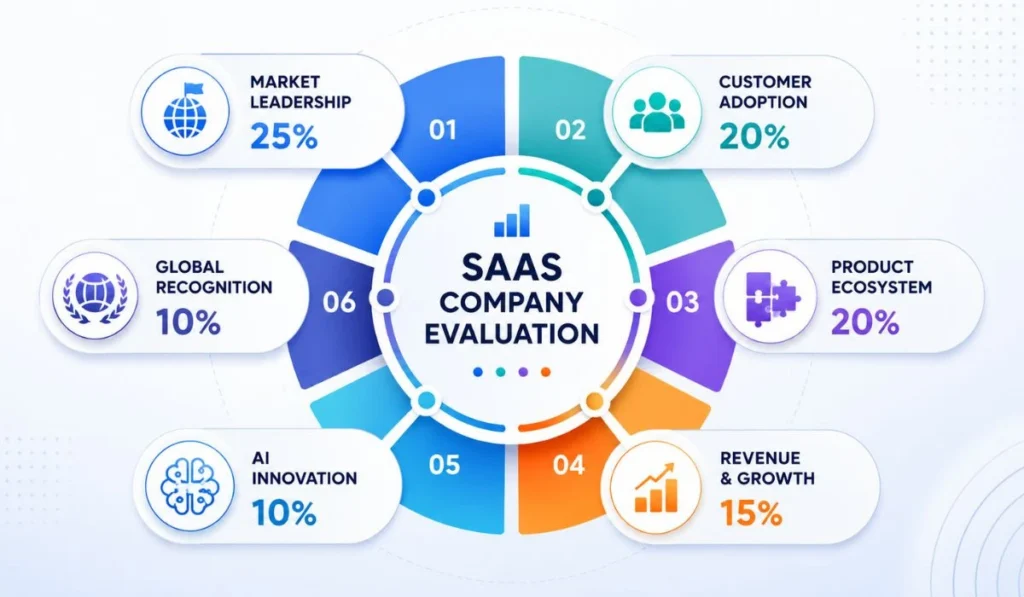
To account for this, we took several other factors into consideration for the creation of this list of top Saas Companies. They include, Global market leadership, Enterprise and customer adoption, Product ecosystem and breadth, Revenue scale or credible growth, AI and product innovation, and International recognition.
Below is a table depicting the evaluation factors and weightage given to them in respect to this list.
| Criterion | Weightage |
| Global market leadership | 25% |
| Enterprise and customer adoption | 20% |
| Product ecosystem and breadth | 20% |
| Revenue scale or credible growth | 15% |
| AI and product innovation | 10% |
| International recognition | 10% |
You will find diversified companies such as Google and Microsoft in this list as their SaaS portfolios have undeniable global influence.
With the dynamic nature of the SaaS industry, this list cannot stay concrete. It should be reviewed annually to accommodate recent developments, including the growth of new products and companies and the decline of older established companies and products.
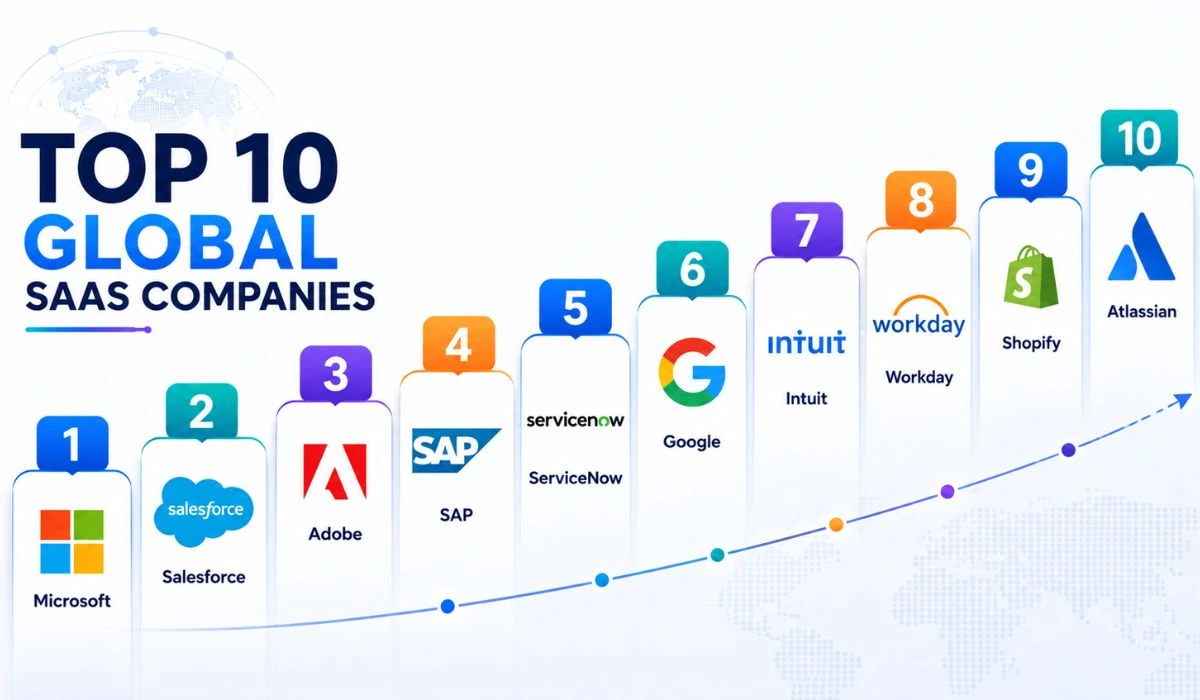
Top 10 Global SaaS Companies
1. Microsoft
Founded: 1975
Headquarters: Redmond, Washington, USA
Ownership: Public Company
Category: Diversified, Horizontal SaaS
Core products: Microsoft 365, Microsoft Teams, OneDrive
Primary audience: Commercial and Enterprise Organisations
Recent innovation or update: AI Integration
Why it is included: Microsoft has managed to turn its large portfolio of desktop software into SaaS products. Their products like Microsoft 365, Dynamic 365, and Teams generate massive amounts of revenue and provide value for their customers.
2. Salesforce
Founded: 1999
Headquarters: San Francisco, California, USA
Ownership: Public Company
Category: Customer Relationship Management (CRM)
Core products: Salesforce Customer Relationship Management (CRM)
Primary audience: Large B2B Companies
Recent innovation or update: Agentic Enterprise
Why it is included: Salesforce provides CRM software, the world’s most widely used CRM. It has been named the #1 CRM for the last 13 years according to the IDC (International Data Corporation) semiannual Core AI Software Tracker, H2 2025
3. Adobe
Founded: 1982
Headquarters: San Jose, California, USA
Ownership: Public Company
Category: Vertical SaaS, Cloud Provider
Core products: Creative Cloud (Photoshop, PremierePro), Document Cloud (Acrobat), and Experience Cloud (Adobe Experience Manager, Adobe Analytics)
Primary audience: Creative Professionals, Businesses, Marketing Departments, Students and Teachers
Recent innovation or update: Adobe Commerce as a Cloud Service (ACCS)
Why it is included: Adobe is another one of the diversified software companies that made the turn from physical storage based software to SaaS at the right moment. They were also one of the quickest to adopt and integrate Artificial Intelligence.
4. SAP
Founded: 1972
Headquarters: Walldorf, Baden-Württemberg, Germany
Ownership: Public Company
Category: B2B ERP (Enterprise Resource Planning)
Core products: SAP S/4HANA Cloud, SAP SuccessFactors, SAP Analytics Cloud
Primary audience: Small-to-medium B2B Companies, Large Enterprises
Recent innovation or update: A Winston (AI Agent Assistant, acquired from the acquisition of SmartRecruiters)
Why it is included: SAP is the largest ERP provider globally (source). It used to be on-premise and made the shift. Its AI integration (The Autonomous Enterprise)
5. ServiceNow
Founded: 2003
Headquarters: Santa Clara, California, U.S
Ownership: Public Company
Category: Enterprise Saas
Core products: IT Service Management (ITSM), IT Operations Management (ITOM), Employee Center/HR Service Delivery, and Customer Service Management (CSM)
Primary audience: Large Enterprises, Government Agencies
Recent innovation or update: Autonomous Security (AI Powered), AI Control Tower
Why it is included: ServiceNow has a loyal customer base. In the second quarter of 2026, it reached a revenue of $3877 million in subscription revenue representing 24.5% year-over-year growth according to their official press release (source). According to the same source, ServiceNow’s total revenue for the same quarter shows a 24% year-over-year growth with $3987 million.
6. Google
Founded: 2006
Headquarters: Mountain View, California, USA
Ownership: Public, private or subsidiary
Category: B2B
Core products: Google Workspace, Google Analytics
Primary audience: Large and Small Businesses, Individuals
Recent innovation or update: Agentic AI
Why it is included: Google is a diversified software company. It turned to SaaS with Google Workspace. It has billions of active users across the world making it one of the most used productivity software. In terms of revenue growth, Google Cloud revenue reached $24.8 billion representing an 82% growth according to official press releases (source)
7. Intuit
Founded: 1983
Headquarters: Mountain View, California, USA
Ownership: Public Company
Category: Financial Technology (FinTech), B2B/B2C
Core products: QuickBook, Credit Karma, TurboTax, Mailchimp
Primary audience: Small-to-medium Businesses, Accounting Professionals,
Recent innovation or update: Intuit Intelligence AI
Why it is included: Intuit’s acquisition of Credit Karma and Mailchimp in 2020 and 2021 respectively was a crucial business move. These multibillion dollar acquisitions turned the standalone tax and accounting software company into a major FinTech powerhouse. In 2026, according to the official website, Intuit has grown its revenue by 10%. (source)
8. Workday
Founded: 2005
Headquarters: Pleasanton, California, USA
Ownership: Public Company
Category: Enterprise Resource Planning (ERP) and Human Capital Management (HCM)
Core products: Workday Human Capital Management (HCM), Workday Financial Management, Workday Adaptive Planning, and Workday Payroll
Primary audience: Large Global Enterprises, Mid-market companies
Recent innovation or update: AI Interface (Sana)
Why it is included: Workday is one of the companies that managed to make the AI turn successfully. It adopted Agentic AI to automate finance and HR workflows. For 20267, the official Workday website reports a total revenue amounting to $9.5 billion, which is a 13.1% increase in year-by-year. (source)
9. Shopify
Founded: 2006
Headquarters: Ottawa, Ontario, Canada
Ownership: Public Company
Category: E-commerce
Core products: E-commerce Platform
Primary audience: Merchants (both big and small sellers), Partners (Technology Experts, App Developers)
Recent innovation or update: Universal Commerce Protocol (UCP)
Why it is included: Shopify’s massive ecommerce platform facilitates business in over 175 countries across the world. In its report of the second quarter of 2026, Shopify reports an increase of 34% in revenue growth and 18% in free cash flow margins. (source)
10. Atlassian
Founded: 2002
Headquarters: Sydney, New South Wales, Australia
Ownership: Public Company
Category: Project Management and Collaboration Software
Core products: Jira, Confluence, Trello, Loom
Primary audience: Software Developers, Engineering Teams, and Technical Product Managers
Recent innovation or update: Rovo AI agents in Jira
Why it is included: Atlassian’s strength in 2026 seems to be its rapid adoption of the Rovo AI for its collaboration software, particularly for teams involved in product management. It has grown its total revenue 28% year-over-year to $1.8 billion and its Cloud revenue growth climbed to 31% year-over-year for the fourth quarter (Atlassian’s fiscal year ended on June 30th, 2026) according to official sources. (source)
Leading SaaS Companies by Category
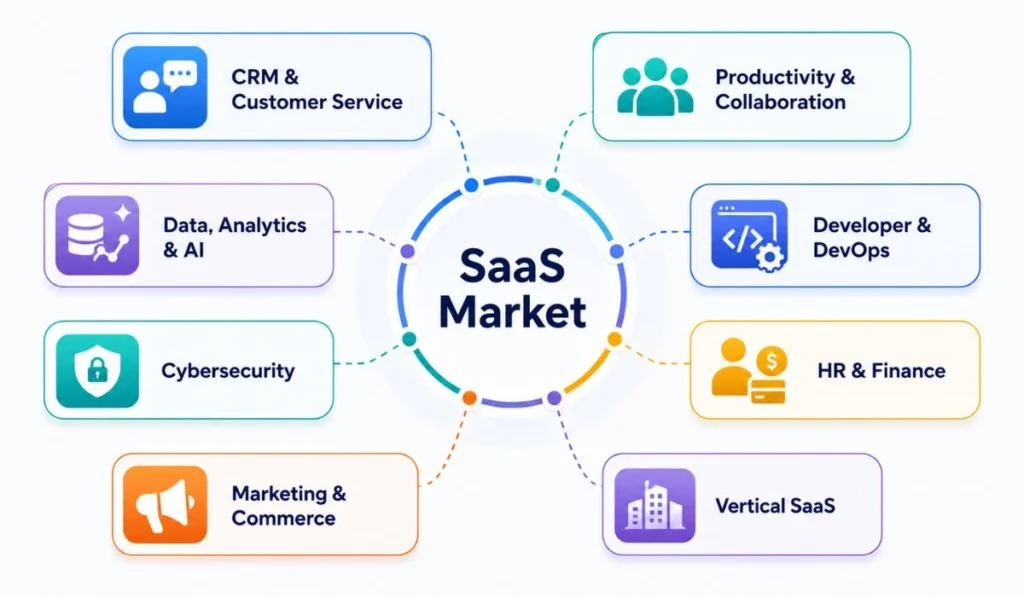
CRM, Sales and Customer Service
| Company | Core Products | Best Used By |
| HubSpot | Smart CRM | SMBs (small-to-medium businesses), Mid-market Organisations |
| Zendesk | Customer Service Software (Zendesk Support, Zendesk Guide, etc) | Mid-market to Large Enterprise Organisations |
| Intercom | Customer Service (Omnichanel, Fin AI Agent, Help Center, etc) | Mid-market to Large Enterprise Organisations |
| Freshworks | Customer Support (Freshdesk), IT service management (Freshservice) | SMBs, Mid-market Organisations |
| Pipedrive | Customer Relationship Management | SMBs |
| Outreach | sales execution and engagement (Engage, Call, Kaia, Deal, Amplify, etc.) | Mid-market to Large Enterprise Organisations |
| Front | Customer Support | Mid-market to Large Enterprise Organisations |
Productivity and Collaboration
| Company | Core Product | Best Used By |
| Google Workspace | Gmail, Calendar, Drive, Docs, Sheets, Slides | SMBs to Large Enterprises, Schools, Institutions, etc |
| Microsoft 365 | Outlook, Excel, Words, Spreadsheet, etc | SMBs to Large Enterprises, Schools, Institutions, etc |
| Notion | Notion Docs/Wikis, Notion Projects, Notion Calendar, and Notion AI/Custom Agents | SMBs, Individuals |
| monday.com | Monday Work Management, Monday CRM, Monday Dev, and Monday Service | SMBs, Mid-market to Enterprise Organisations |
| ClickUp | Clickup Tasks, Clickup Docs, Clickup Brain, etc. | SMBs |
| Airtable | Bases, Interface Designer, Automations, and AI Agents | SMBs |
| Zoom | Zoom Workplace | SMBs to Large Enterprises, Schools, Institutions, etc |
| Dropbox | Dropbox Cloud Storage/File Sync, Dropbox Dash, Dropbox Replay, and Dropbox Sign/DocSend | SMBs |
Data, Analytics and AI
| Company | Core Product | Best Used By |
| Snowflake | Data Warehousing, Data Lake, Data Engineering, Data Sharing, Data Applications, Snowpark | Mid-market to Large Enterprise Organisations |
| Databricks | Delta Lake,Unity Catalog, Lakeflow, Databricks SQL, MLflow | Upper mid-market to Large Enterprise Organisations |
| OpenAI | ChatGPT, ChatGPT team, ChatGPT Enterprise, etc. | SMBs to Large Enterprises, Schools, Institutions, Individuals etc |
| MongoDB | MongoDB Atlas, MongoDB Enterprise Advanced, MongoDB Community Server | Mid-market to Large Enterprise Organisations |
| Datadog | APM (Application Performance Monitoring), Infrastructure Monitoring, Digital Experience Monitoring (DEM) | Mid-market to Large Enterprise Organisations |
Developer and DevOps Platforms
| Company | Core Product | Best Used By |
| GitHub | Github Free and Team, Github Enterprise | SMBs to Large Enterprises |
| GitLab | portfolio management, source code management, as well as continuous integration and continuous deployment (CI/CD) | Large Enterprises |
| BrowserStack | Live, Automate, App Live, App Automate, Percy, etc. | Mid-market to Large Enterprise Organisations |
| CircleCI | CircleCI Pipelines, Orbs, CircleCI Runner, Insights, etc | SMBs to Large Enterprises |
| PagerDuty | Incident Management, AIOps, Process Automation, AI Agents | Mid-market to Large Enterprise Organisations |
| Sentry | Application performance monitoring (APM), Error tracking, Session Replay, etc | SMBs to Large Enterprises |
Cybersecurity and Identity
| Company | Core Product | Best Used By |
| CrowdStrike | Falcon Insight XDR, Falcon Cloud Security (CNAPP), Falcon Identity Protection, Falcon LogScale, etc | Large Enterprises |
| Cloudflare | Cloudflare CDN, DDoS Mitigation, Cloudflare Workers, Zero Trust Security, DNS and SSL, etc. | SMBs to Large Enterprises |
| Okta | Workforce Identity Cloud and Customer Identity Cloud | Mid-market to Large Enterprise Organisations |
| KnowBe4 | AI-Native Security Awareness Training, PhishER / PhishER Plus, ,SecurityCoach | Mid-market to Large Enterprise Organisations |
HR and Finance
| Company | Core Product | Best Used By |
| Workday | Workday Human Capital Management (HCM), Financial Management, Adaptive Planning, Payroll | Mid-market to Large Enterprise Organisations |
| Gusto | Full-Service Payroll, Benefits Administration, HR and Onboarding, etc | SMBs |
| BambooHR | BambooHR Employee Record, Time Tracking Software, Absence management software | SMBs |
| BILL | Accounts Payable Software (AP), Accounts Receivable, BILL Spend & Expense (formerly Divvy) | SMBs |
| Xero | Ledger & Cashbook for Accountants,Billing and Invoicing software, Hubdoc, Xero Projects | SMBs |
| Intuit | TurboTax, Credit Karma, Mailchimp, Intuit Enterprise Suite, Intuit Accountant Suite | SMBs to Large Enterprises |
| ADP | RUN, Roll, Workforce Now, ADP Lyric HCM or ADP Vantage HCM, TotalSource (PEO) | SMBs to Large Enterprises |
Marketing and Commerce
| Company | Core Product | Best Used By |
| Shopify | Shopify Online Store, Shopify POS (point of sale), Shopify Checkout, Shopify Capital,Shopify Payment, Shopify Shipping | SMBs to Large Enterprises |
| Canva | Canva Docs, Canva Presentations, Visual suite, Canva Whiteboards, Magic Studio, etc | SMBs to Large Enterprises, Schools, Institutions, Individuals etc |
| Klaviyo | Email Marketing, SMS & MMS Marketing, Mobile Push & WhatsApp, Predictive Analytics & AI | SMBs to mid-market Organisations |
| Braze | Braze Data Platform, Canvas Journey Orchestration, BrazeAI | Mid-market to Large Enterprise Organisations |
| Semrush | SEO Toolkit,Content Toolkit, Competitive Research Toolkit, Advertising Toolkit, Social Media Toolkit | SMBs to Large Enterprises |
| Typeform | Form Builder, VideoAsk, Growth & Research Flows | SMBs to Large Enterprises |
| Mailchimp (acquired by Intuit) | Email & SMS Marketing, Customer Journeys & Automation, Segmentation & Analytics, Intuit Assist & Analytics AI | SMBs to mid-market organisations |
Vertical SaaS
| Company | Core Product | Best Used By |
| Veeva Systems | Vault CRM, Veeva Commercial Cloud, Veeva Data Cloud | Large Pharma Enterprises, Mid size biotechs (Life Sciences Industry) |
| Toast | Point of Sale (POS) Software, Payment and Credit Card Processing, Kitchen Display System (KDS), Digital Ordering & Delivery, Payroll & Team Management, Inventory Management, Invoice Management | SMBs to mid-market Organisations (Restaurant and Food Service Industry) |
| Procore | Project Execution, Financial Management, Resource Management, Preconstruction | Mid-market to Large Enterprise Organisations (Construction Industry) |
| Samsara | Vehicle Telematics, AI Dash Cams & Fleet Video Safety Platform, GPS Asset Tracking Solution & Software, Workflows and Resources for Drivers | Mid-market to Large Enterprise Organisations ( Connected Operations: Transport and Logistics Industry, Construction, etc.) |
AI-Native and Fast-Growing SaaS Companies
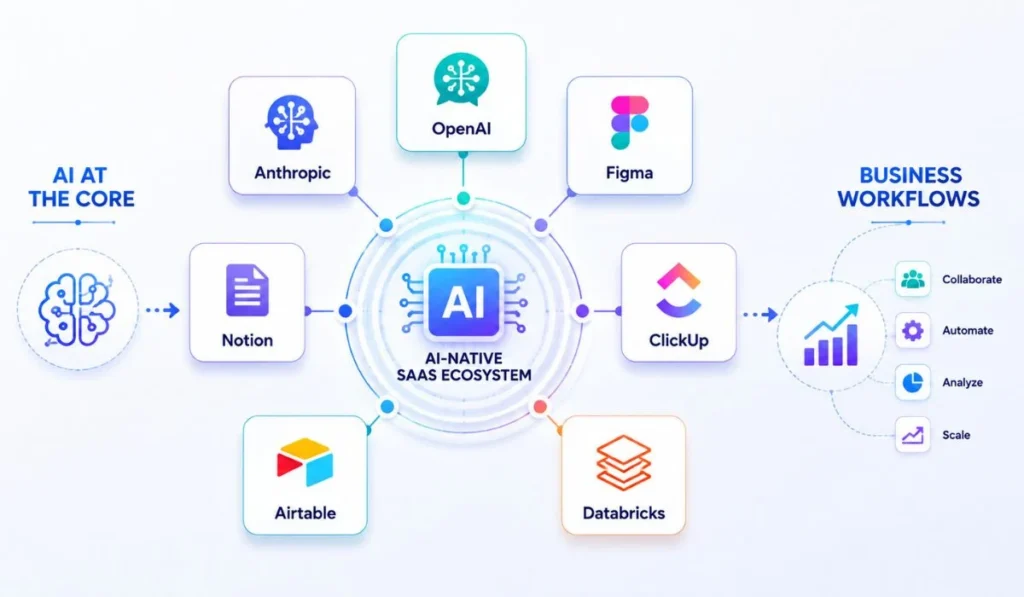
Traditional SaaS software is scrambling to adapt to AI and the ones that do so successfully are seeing massive levels of growth, expansion and stability. Then there are the modern SaaS software companies with AI at its centre. Artificial Intelligence is embedded into the foundations of such companies. Examples include
- OpenAI
- Anthropic
- Figma
- Notion
- ClickUp
- Airtable
- Databricks
Other Notable SaaS Vendors
- Parallels
- SolarWinds
- Help Scout
- Gusto
- BambooHR
- Lever
- Typeform
- Userpilot
- BrowserStack
- CircleCI
- PagerDuty
- Sentry
- Pipedrive
- Outreach
- Dropbox
- Elementor
- Sketch
- Zeplin
- WP Engine
- Avalara
- ADP
- Act-On
- Yesware
- GoTo
Frequently Asked Questions
A SaaS (Software as a Service) company is a company that provides software applications over the internet without any installation in a subscription based system.
Yes. Microsoft is a major SaaS company but it is diversified.
Yes. Google is a SaaS company but it is also a diversified tech company.
The leading AI SaaS companies are OpenAI and Anthropic.
Vertical SaaS is a software created for a specific industry
A business should consider factors like technology, security, service, compliance, integration and many more before choosing a SaaS vendor
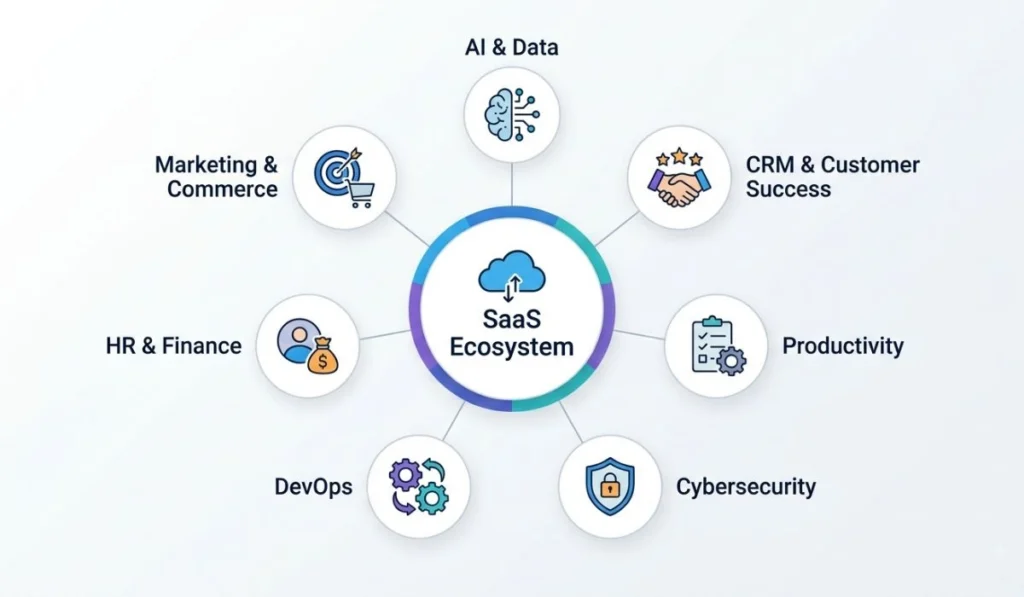
The fastest-growing SaaS categories include:
1. CRM, Sales and Customer Service
2. Productivity and Collaboration
3. Data, Analytics and AI
4. Developer and DevOps Platforms
5. Cybersecurity and Identity
6. HR and Finance
7. Marketing and Commerce